
Understanding how Vennlisk makes money and creates value for clients should be one of the first steps in preparing for the CIMA Strategic Case Study November 2026–February 2027 exam.
Vennlisk is a quoted Westlandian company specialising in outsourced inbound call-centre services. It handles calls on behalf of organisations that choose not to manage all their inbound customer-service activities internally.
Join our Free SCS Mini Course:
https://learn.keystoneacademia.com/course/cima-scs-nov-26-mini-course
Register for the free live session:
Keystone Academia – CIMA SCS Registration
Join our CIMA SCS WhatsApp community:
Join the Keystone Academia CIMA SCS WhatsApp Community
But the important question for an SCS student is not simply:
What does Vennlisk do?
It is:
Why do clients choose Vennlisk, how does Vennlisk create value for them, and what could threaten that value?
How Does Vennlisk’s Business Model Work?
Vennlisk provides inbound-call services to many leading companies in Westland.
It has grown through a combination of organic growth and acquisitions and now employs 5,000 agents across five call centres, each situated in a major Westlandian city.
Its clients operate across several sectors, including utilities, healthcare, banking and financial services, insurance, online retail, the public sector, travel and hospitality.
This gives us a simple business model:
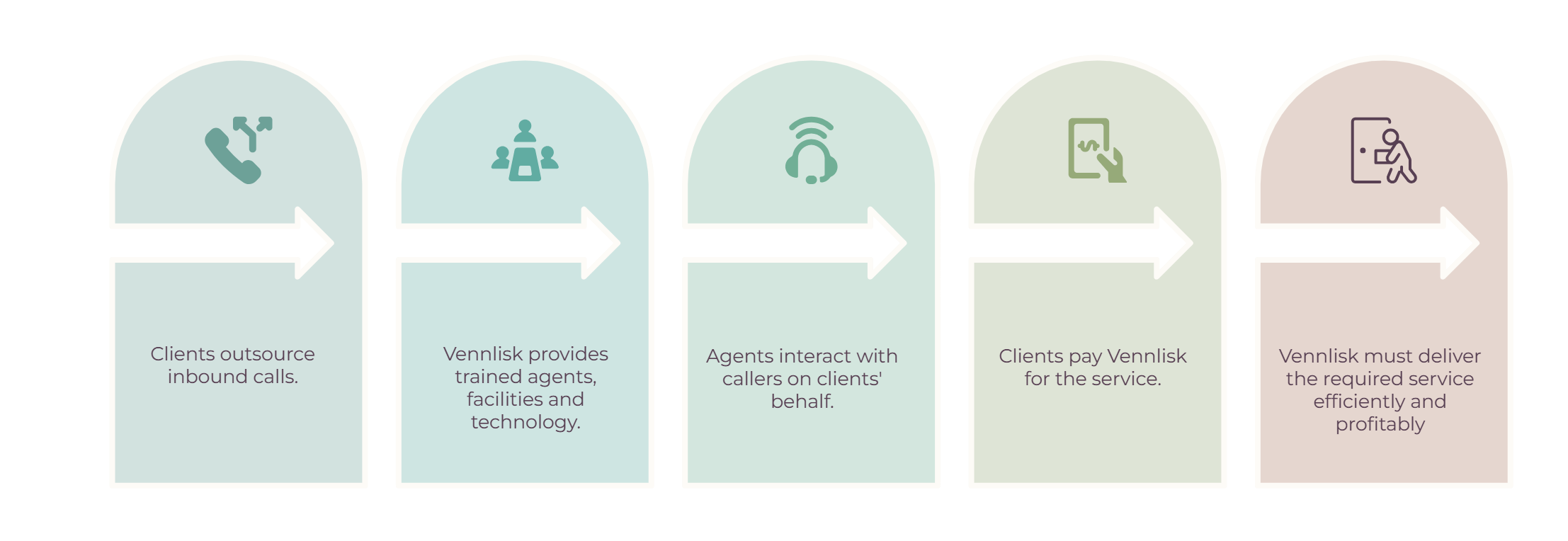
However, the model becomes more interesting when we consider the two types of inbound call-centre arrangements.
Shared vs Dedicated Call Centres
The call-centre industry uses both shared and dedicated models.
Shared inbound call centres
A shared centre uses pools of agents to handle calls for multiple clients.
Clients are charged for the actual agent time associated with their calls.
This can suit organisations with lower or unpredictable call volumes because they do not need to pay continuously for dedicated capacity.
Vennlisk implication
Shared arrangements can improve flexibility, but agents may need knowledge of several different clients.
That potentially increases the importance of:

Dedicated inbound call centres
Dedicated arrangements allocate pools of agents to individual clients.
This allows agents to receive more detailed training relating to that particular client’s requirements.
Clients generally pay hourly rates for the agents’ time, whether those agents are fully occupied with calls or not. This model is more suitable where call volumes are relatively constant.
Most Vennlisk clients use dedicated inbound call centres, although some use shared arrangements.
Why does this matter?
Dedicated agents can potentially develop deeper client knowledge.
That may support:
- better customer service
- higher First Call Resolution
- greater consistency
- stronger client relationships.
But there is also a financial issue.
If agents are dedicated to a client but call volumes are lower than expected, those employees still represent capacity that needs to be managed.
This creates an important Vennlisk relationship:

Why Do Companies Outsource Their Call Centres?
Organisations could operate their own call centres.
So why use a company like Vennlisk?
The industry information identifies several potential advantages.
1. Lower costs and greater efficiency
Specialist providers manage the necessary technology and infrastructure.
Clients therefore avoid having to manage all of these investments themselves.
2. Scalability
Outsourced providers can potentially increase or decrease agent numbers more quickly in response to client needs.
This can be valuable when call volumes fluctuate.
3. Specialist expertise
A provider such as Vennlisk develops experience in managing large volumes of customer interactions.
Vennlisk also invests heavily in employee training.
4. Access to technology
Specialist providers can spread the costs of testing and implementing new technology across multiple clients.
This is particularly relevant as AI becomes increasingly important to Vennlisk.
5. Data protection
Outsourcing providers may also be able to offer robust data-protection and backup arrangements.
What Is Vennlisk Really Selling?
It would be too simplistic to say:
“Vennlisk sells call-centre hours.”
What Vennlisk is really offering clients includes:
- trained employees
- customer-service expertise
- technology
- capacity
- scalability
- reliability
and ultimately:
the ability to manage the client’s relationship with callers effectively.
This is important because Vennlisk’s agents effectively represent its clients during calls.
A caller who receives poor service may blame the organisation they called — not Vennlisk.
Therefore, poor performance could damage both:
Vennlisk’s reputation and
the client’s reputation.
That makes service quality a strategic issue.
People Are Central to Vennlisk’s Business Model
Vennlisk has a strong reputation for employing and training competent staff.
New agents receive basic customer-care training before receiving additional preparation relating to the particular clients whose calls they will handle. Training then continues throughout employment.
The training is not purely technical.
Agents may also need emotional skills.
For example, someone handling insurance claims may need to deal sympathetically with a caller who has experienced an accident, while someone handling calls for an online retailer may need strong product knowledge and a friendly sales-oriented approach.
Strategic implication
This suggests Vennlisk’s workforce is not simply a cost.
Its trained employees are potentially an important source of competitive advantage.
That also explains why losing experienced employees could be strategically damaging.
The Central Vennlisk Challenge: Quality vs Cost
Vennlisk operates in a labour-intensive industry.
This means employee costs matter.
At the same time, its reputation depends heavily on the quality of its people.
This creates one of the most important tensions in the entire case:
How can Vennlisk remain cost competitive without damaging the service quality that differentiates it?
Reducing staff costs too aggressively could potentially lead to:
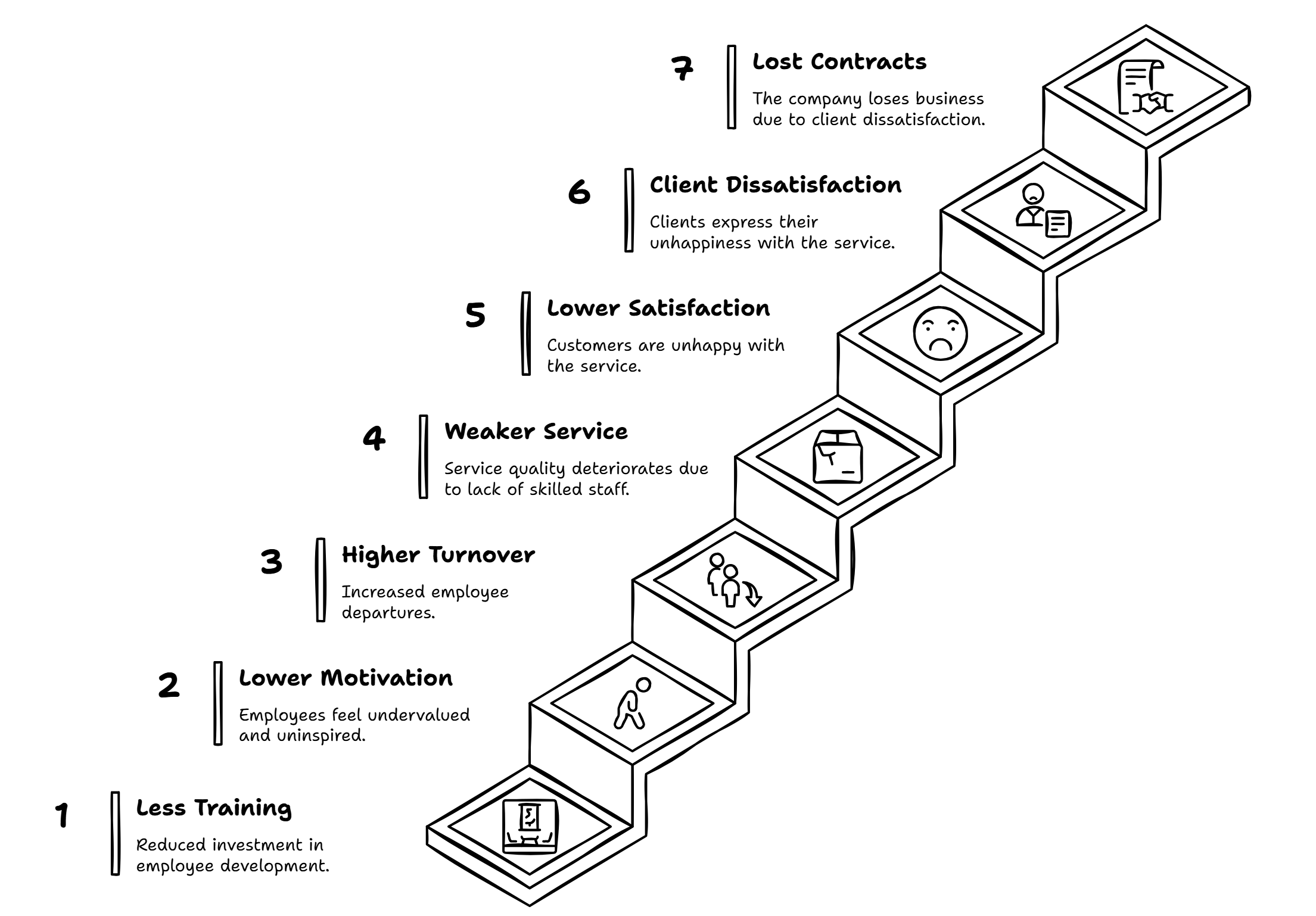
So a cost reduction that looks attractive financially could ultimately destroy value.
International Competition Makes This Harder
Vennlisk is not protected simply because its call centres are in Westland.
Call-centre services can potentially be provided from lower-cost countries.
That means overseas competitors may enjoy significantly lower labour costs.
Vennlisk therefore faces a strategic choice.
Trying to compete purely on price may be difficult.
Instead, it may need to justify its position through:
- quality
- reliability
- well-trained employees
- technology
- innovation
- customer experience
- trusted relationships with clients.
This is why the quality vs cost issue deserves serious attention in your Vennlisk SCS preparation.
Technology Could Change the Business Model
Call centres depend heavily on technology.
For Vennlisk, technology can support:
- call routing,
- access to client information,
- performance monitoring,
- customer interaction,
- potentially AI-assisted decision-making.
The key strategic question is therefore not:
“Should Vennlisk use technology?”
It already depends heavily on technology.
The more useful question is:
How far should Vennlisk automate its service while protecting the human qualities that clients and callers value?
This becomes particularly important because Vennlisk is evaluating artificial intelligence.
We will explore this separately in our dedicated Vennlisk AI analysis.
Key Risks in Vennlisk’s Business Model
Several vulnerabilities emerge directly from understanding how Vennlisk operates.
Employee dependency
Service quality depends heavily on trained and experienced agents.
Telecommunications dependency
Without reliable telecommunications links, Vennlisk cannot provide its core service effectively.
Privacy
Agents require access to client information, creating privacy and security responsibilities.
Technology
Technology can improve efficiency but can also create implementation and operational risks.
Competition
Lower-cost overseas providers can create significant pricing pressure.
Client relationships
Poor service could damage clients’ reputations and threaten future contracts.
These issues show why the business model connects directly to E3, P3 and F3.
What Should Vennlisk’s Board Focus On?
From the perspective of a senior finance manager advising the Board, several priorities stand out.
Protect service quality. Vennlisk’s reputation depends heavily on the experience clients and callers receive.
Retain and develop employees. Training creates value only if Vennlisk can retain capable agents.
Use technology intelligently. AI and automation should improve service and productivity rather than simply reduce headcount.
Understand client profitability. Revenue alone does not necessarily mean a contract creates sufficient value once staffing, training and capacity requirements are considered.
Maintain operational resilience. Telecommunications, systems and client information must remain available and secure.
Monitor competitors. Vennlisk needs to understand whether its quality differentiation is sufficient to justify its cost position.
CIMA SCS Exam Relevance
The business model could connect to many plausible unseen developments.
For example, the Board could be asked to consider:
- a major new client
- a change in pricing
- an AI investment
- an overseas competitor
- a capacity problem
- a client complaint
- an acquisition
- a technology failure.
These are possible scenarios, not predictions.
Whatever the unseen introduces, start by asking:
How does this development affect the way Vennlisk creates value for clients?
That question will usually lead you toward stronger analysis.
Final Takeaway
Vennlisk is much more than a company that answers telephone calls.
Its business model combines:
People + Training + Technology + Capacity + Client Knowledge + Customer Experience
The challenge is to combine those resources efficiently enough to remain profitable while maintaining the service quality required to compete.
For CIMA SCS students, the key is therefore not to memorise how shared and dedicated call centres work.
Understand what those models mean for:
- cost
- capacity
- training
- quality
- risk
- profitability
- competitive advantage.
That is where the exam value lies.
FAQs
What is Vennlisk’s business model?
Vennlisk provides outsourced inbound call-centre services to organisations in Westland. Most clients use dedicated inbound arrangements, although some use shared services.
How many employees does Vennlisk have?
Vennlisk employs 5,000 agents across five call centres located in major Westlandian cities.
What is the difference between shared and dedicated call centres?
Shared arrangements use pools of agents serving multiple clients, while dedicated arrangements allocate agents to individual clients and can support more specialised training.
What could give Vennlisk a competitive advantage?
Potential sources include its trained workforce, reputation for quality, client-specific knowledge, technology, service quality and innovation.
What is one of Vennlisk’s biggest strategic challenges?
A major challenge is balancing cost competitiveness with service quality, particularly when competing against providers with lower labour costs.
Join our Free SCS Mini Course:
https://learn.keystoneacademia.com/course/cima-scs-nov-26-mini-course
Register for the free live session:
Keystone Academia – CIMA SCS Registration
Join our CIMA SCS WhatsApp community:
Join the Keystone Academia CIMA SCS WhatsApp Community
Continue Your Vennlisk Pre-Seen Preparation
Understanding the business model is only the beginning.
Next, we examine the numbers behind the company:
Vennlisk Financial Analysis: Performance, Profitability, Debt & Shareholder Value
Follow Keystone Academia’s Vennlisk CIMA SCS series for applied pre-seen analysis, exam technique and revision support for the November 2026–February 2027 exam cycle.