

The CIMA Strategic Case Study (SCS) is the final hurdle in your professional journey. It is a high-stakes simulation of your role as a Senior Finance Manager responsible for strategic decision-making at the corporate level.
To succeed in the May 2026 exam window, candidates must move beyond tactical management and focus on long-term value creation, risk appetite, and corporate governance.
This guide explains how to analyse the pre-seen strategically, focus on high-impact topics, and structure answers in a way that aligns with what CIMA examiners expect.
I. Strategic Ecosystem Analysis: The Intelligence Phase
When the May 2026 Pre-Seen is released on April 2, your role shifts from student to strategic advisor to the Board.
At this level, analysis focuses on the external environment, corporate strategy, and long-term organisational sustainability.
Strategic DNA Extraction (E3)
Begin by evaluating the company’s mission, vision, and long-term strategic direction.
Consider questions such as:
-
Is the organisation’s current strategy sustainable?
-
Are digital disruptors or new competitors threatening the business model?
-
Does the organisation have a strong strategic position in its industry?
Understanding the strategic DNA allows you to evaluate whether the organisation’s long-term direction is viable.
Apply the Triple Pillar Analysis (E3, P3, F3)
Enterprise (E3)
Analyse the corporate ecosystem and digital strategy.
Focus on:
-
Strategic partnerships
-
Business ecosystems
-
Digital transformation initiatives
-
Competitive positioning
Performance (P3)
Focus on the organisation’s risk management framework.
Identify the strategic risks that could threaten the survival of the organisation rather than simply affecting operational performance.
Examples include:
-
Technological disruption
-
Market decline
-
Regulatory risk
-
Strategic execution risk
Financial (F3)
Evaluate corporate financing and capital structure.
Key areas to analyse include:
-
Dividend policy
-
Capital structure decisions
-
Impact on Weighted Average Cost of Capital (WACC)
-
Shareholder value creation
Establish the Boardroom Anchor
Strong SCS answers rely on strategic financial interpretation.
Select 5 to 8 strategic performance metrics, such as:
-
Price Earnings (P/E) Ratio
-
Total Shareholder Return (TSR)
-
Gearing Ratio
-
Return on Capital Employed (ROCE)
For example:
Instead of saying:
“The company has high debt.”
A stronger answer would be:
“The company’s gearing ratio is significantly higher than industry levels, which increases financial risk and may negatively affect shareholder confidence.”
Linking strategy to shareholder value carries significant weight in the SCS exam.
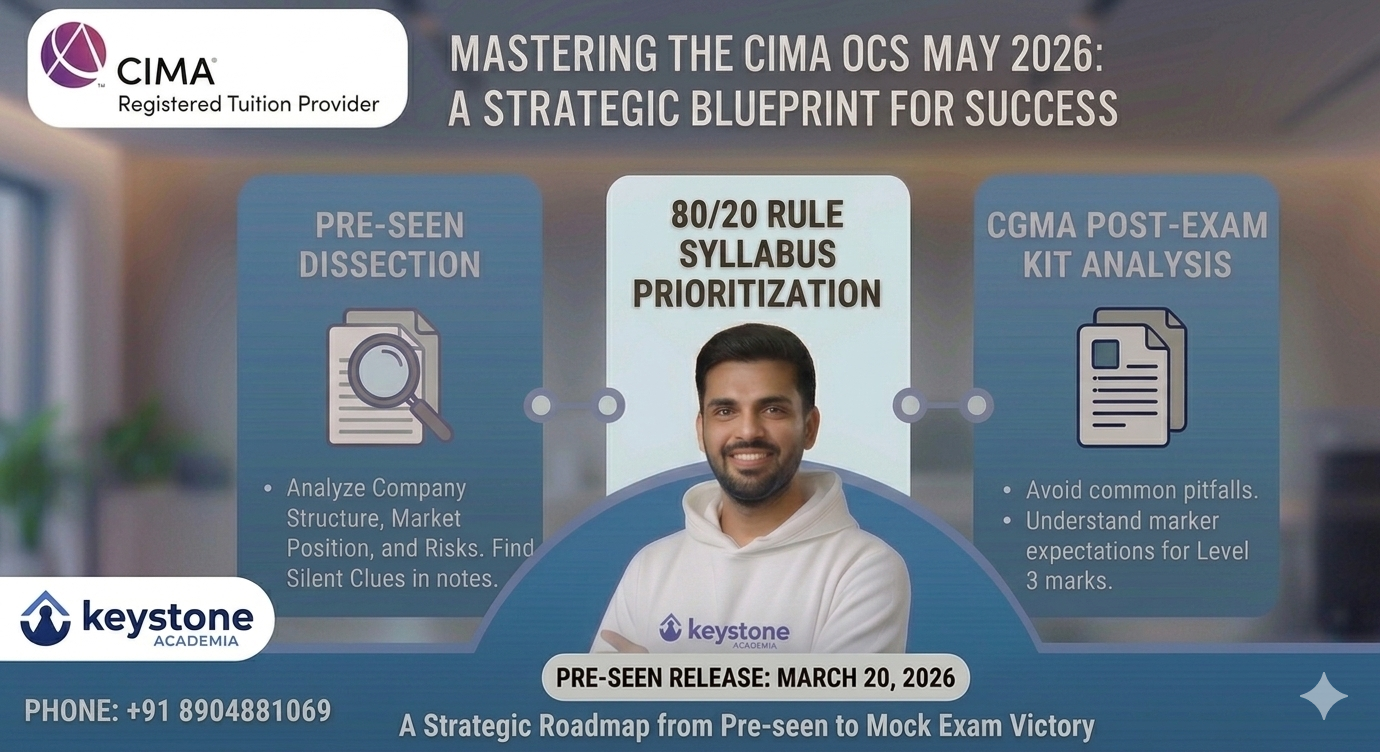
II. The 80/20 Rule: Strategic Content Selection
The SCS syllabus covers a wide range of strategic topics, but the exam typically focuses on a smaller group of high-impact themes.
Your goal is to focus on the 20 percent of topics that influence 80 percent of boardroom decisions.
Identify the Frequent Exam Topics
Based on recent CGMA Post Exam Kits, common high-scoring areas include:
-
Mergers and acquisitions or disposals (F3)
-
Risk identification and mitigation (P3)
-
Strategic change management (E3)
-
Corporate governance
-
Strategic performance evaluation
These topics frequently appear in the SCS exam and should receive priority in your preparation.
Conduct a Strategic Knowledge Heat Map
Create a structured knowledge audit to identify your strengths and weaknesses.
Classify each topic into three categories.
Green – Mastery
You can confidently defend a strategic proposal to the Board of Directors.
Amber – Functional
You understand the theory but struggle to evaluate the long-term implications.
Red – Critical Gap
These are priority revision areas where you cannot yet connect theory to corporate strategy.
Your objective is to move all red topics into the green mastery zone before the exam.
III. Global Industry Awareness and Strategic Thinking
CIMA rewards candidates who demonstrate strong industry awareness and the ability to think globally.
Research the real-world equivalent of the pre-seen organisation and identify major industry trends.
Identify Global Strategic Trends
Examples of macro trends include:
-
Geopolitical instability
-
Global interest rate changes
-
Supply chain transformation
-
ESG and sustainability regulations
-
Digital disruption
However, simply mentioning industry trends is not enough.
You must explain the strategic implications for the organisation.
Apply the “So What” Factor
Basic statement:
“The industry is moving toward renewable energy.”
Professional response:
“The global shift toward renewable energy requires significant capital investment; however, failing to transition could lead to stranded assets and reduced confidence among institutional investors.”
This level of explanation demonstrates board-level strategic thinking.
IV. Structuring Executive-Level Answers
Examiners scan answers quickly. If responses are poorly structured, strong ideas may be overlooked.
Using a clear structure significantly improves readability and marks.
Use the Point – Explain – Apply Framework (PEA)
Each paragraph should follow three steps.
Point
Clearly state the strategic issue.
Explain
Link it to a relevant theory, framework, or risk model.
Apply
Connect the analysis directly to the pre-seen organisation and stakeholders.
Use Bullet Points for Strategic Clarity
Bullet points are particularly effective when presenting:
-
Strategic risks
-
Strategic options
-
Governance recommendations
-
Implementation steps
They help examiners quickly identify key insights.
Maintain a Director-Level Tone
Write as a senior finance professional advising the board.
Use authoritative language such as:
-
The board should consider
-
This aligns with our risk appetite
-
We must protect shareholder value
Also remain alert to complex ethical dilemmas within the scenario.
These situations should be addressed using the CIMA Code of Ethics, particularly when decisions impact stakeholders at the corporate level.
V. May 2026 SCS Preparation Timeline
| Phase | Focus Area | Goal |
|---|---|---|
| Intelligence | Strategic Pre-Seen Analysis | Identify the key strategic issues in the company’s financials and corporate strategy. |
| Refinement | 80/20 Strategic Revision | Strengthen high-impact strategic topics and eliminate knowledge gaps. |
| Simulation | Timed Mock Exams | Build the stamina required to analyse and respond strategically for three hours. |
| Analysis | Post Exam Kit Review | Study examiner reports to understand the mindset required for SCS success. |
Final Thoughts
Success in the CIMA Strategic Case Study exam depends on strategic thinking rather than simply performing calculations.
By identifying high-impact topics, analysing the industry environment, and presenting structured strategic recommendations, candidates can significantly increase their chances of success.
Students who approach the exam with a boardroom mindset often outperform those who rely only on technical knowledge.
Keystone Academia supports CIMA students with structured case study preparation, strategic industry analysis, and mock exam practice designed to simulate the real SCS exam environment.
Interested in our Free Early Prep Guidance?
Register Now: Keystone Academia Free CIMA Case Study Early Prep – Fill in form

Leave a Reply