


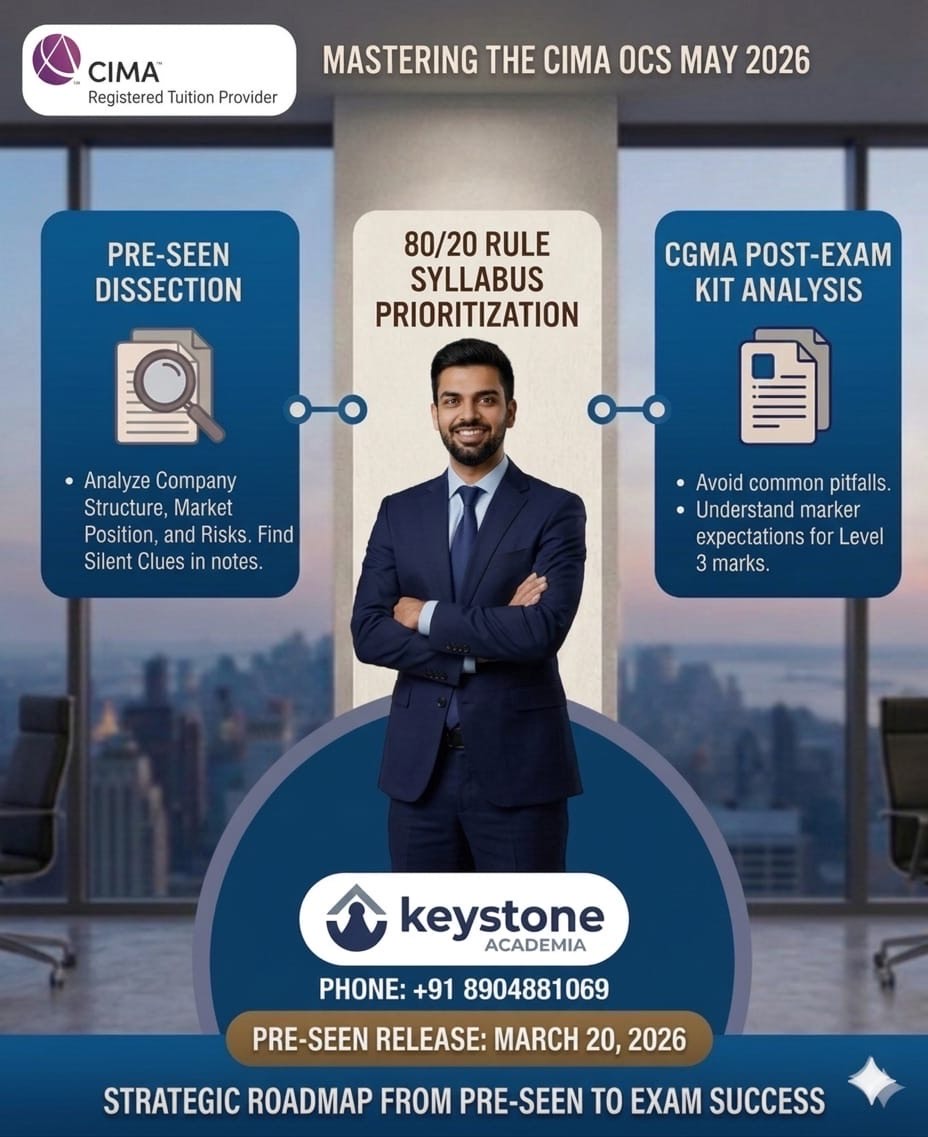
The CIMA Operational Case Study (OCS) is more than an exam; it is a high-stakes simulation of your first 90 days as a Finance Officer. To succeed in the May 2026 window, you must transcend the “textbook” mindset. This guide outlines a professional framework to dissect the pre-seen, master the 80/20 rule, and deliver answers that command marks.
I. The “Intelligence Phase”: Deep-Dive Pre-Seen Analysis
When the May 2026 Pre-seen is released on March 20th, your role changes from student to internal consultant. A surface-level reading is not enough. You must perform a 360-degree Diagnosis:
1. The DNA Extraction (Business Model)
Identify the company’s core value proposition. Is it a cost-leader (high volume, low margin) or a differentiator (premium, niche)? Every recommendation you make in the exam must protect this core identity.
2. The Triple-Pillar Audit (E-P-F)
• Enterprise (E1): Map the digital ecosystem. How does the company leverage data? Are there threats from “disruptors” mentioned in the text?
• Performance (P1): Identify the “Golden Variables.” Which costs, if increased by even 5%, would jeopardise the company’s survival? Look for mentions of variances or budgeting styles.
• Financial (F1): Don’t just look at the profit. Scrutinise the Statement of Cash Flows and Working Capital. Is the company “asset-rich but cash-poor”? This is a classic CIMA trigger.
3. The “KPI Anchor”
Select 5–8 critical financial ratios (e.g., Operating Margin, Interest Cover, Inventory Turnover). Memorise these. Stating “Our gearing ratio is 45%, which is significantly higher than the industry average of 30%” carries far more weight than saying “We have a lot of debt.”
II. The 80/20 Rule: Strategic Content Selection
The CIMA syllabus is vast, but the OCS exam is targeted. To be efficient, you must identify 20% of topics that generate 80% of the marks.
1. Identify the “Frequent Flyers”
Analyze the CGMA Post-Exam Kits from the last four sittings. You will notice a pattern. Topics like Variances (P1), Working Capital Cycles (F1), and Digital Technology/Ethics (E1) are the “heavy lifters.”
2. The “Heat Map” Knowledge Audit
Mark, where you stand today. Create a table of the core syllabus and color-code it:
• Green (Mastery): You can explain this to a non-financial manager without notes.
• Amber (Functional): You know the theory but struggle to apply it to a specific business scenario.
• Red (Critical Gap): These are your priority “Fire Drills.”
III. Industry Immersion & External Highlights
CIMA rewards Industry Awareness. The May 2026 case study will be based on a real-world sector (e.g., Renewable Energy, Retail, or Tech).
• Identify Industry “Pain Points”: Research the real-world equivalent of the Pre-seen company. What are the current headlines? Are they facing labor shortages, supply chain inflation, or new ESG (Environmental, Social, and Governance) regulations?
• The “So What?” Factor: Never state a fact without explaining the impact.
o Basic: “The industry is moving toward automation.”
o Professional: “The industry-wide shift toward automation represents a significant capital expenditure risk, but it is essential for maintaining our long-term cost-competitiveness.”
IV. Answer Architecture: Engineering the Perfect Response
Markers do not read; they scan. If your points are buried in a “wall of text,” you will lose marks.
1. The “Point-Explain-Apply” (PEA) Framework
Every paragraph should follow this structure:
• Point: State the issue clearly.
• Explain: Briefly touch on the underlying theory (e.g., Why a certain IFRS standard applies).
• Apply: Connect it directly back to a character or event in the Pre-seen.
2. Bullet Point Mastery
Use bullet points for lists of risks, benefits, or implementation steps. It demonstrates a structured, logical mind – a trait highly valued in management accountants.
3. Professional Tone & Ethics
You are writing as a Finance Officer. Use active, authoritative language: “I recommend,” “The data suggests,” “We must mitigate.” Always keep an eye out for Ethical Dilemmas; CIMA almost always embeds an ethical “trap” that requires a professional response based on the CIMA Code of Ethics.
V. The May 2026 Execution Timeline
| Phase | Focus Area | Goal |
| Intelligence | Pre-Seen Dissection | Know the “hidden stories” in the financials. |
| Refinement | The 80/20 Topic Polish | Move all “Red” topics to “Amber/Green.” |
| Simulation | Timed Mock Exams | Build the stamina to write for 3 hours straight. |
| Analysis | Post-Exam Kit Review | Study the Examiner’s Reports to avoid common pitfalls. |
Conclusion: Mark Your Starting Point
Success in the OCS is about application, not just calculation. By identifying your 80/20 topics and mastering the “Industry Highlights,” you are already ahead of 90% of the candidates.
Interested in our Free Early Prep Guidance?
Register Now: Keystone Academia Free CIMA Case Study Early Prep – Fill in form

Leave a Reply