
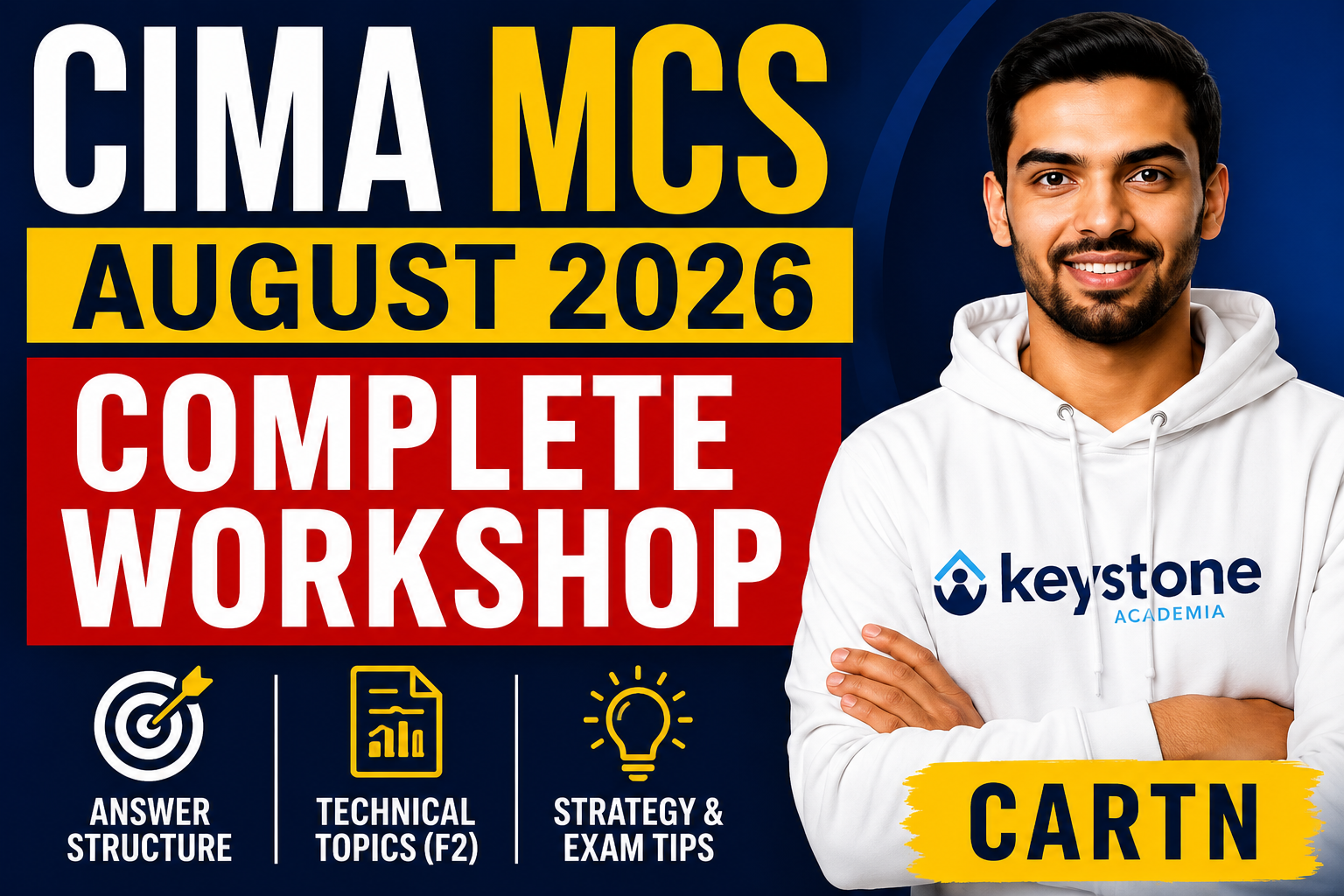
Preparing for the CIMA Management Case Study (MCS) August 2026 examination requires more than memorising technical concepts. The examiner expects you to think like a Finance Manager at Cartn, evaluate business problems commercially, and provide recommendations that are practical, balanced and supported by evidence.
If you are searching for CIMA MCS August 2026 revision, Cartn pre-seen analysis, IAS 37 explained, IAS 38 CIMA, IFRS 15 Revenue Recognition, Risk Management, Investment Appraisal, or CIMA answer structure, this guide and workshop will help you prepare for success.
Watch the complete workshop here: https://youtu.be/hZTgoc8D62w
Why This Workshop Matters for CIMA MCS August 2026
One of the biggest reasons students fail the Management Case Study is not because they lack technical knowledge. They fail because they cannot apply that knowledge to the Cartn business scenario.
High-scoring candidates demonstrate:
- Commercial awareness
- Professional communication
- Clear answer structure
- Business judgement
- Strategic thinking
- Financial awareness
- Stakeholder consideration
Every recommendation should relate back to Cartn’s business model, competitive environment, financial objectives and long-term strategy.
Mastering Answer Structure
Answer structure is one of the easiest ways to gain marks.
Many candidates immediately start explaining theory without addressing the requirement.
Instead, structure every answer like a Finance Manager:
Business Context
Explain the issue facing Cartn.
Technical Knowledge
Apply the relevant E2, P2 or F2 concept.
Commercial Application
Discuss the impact on customers, suppliers, operations and financial performance.
Recommendation
Provide a practical recommendation supported by business evidence.
This approach demonstrates professional competence and directly aligns with examiner expectations.
IAS 37 – Provisions, Contingent Liabilities and Contingent Assets
IAS 37 is a common F2 topic that could easily appear in the Cartn case study.
Students should understand:
- When to recognise a provision
- When to disclose a contingent liability
- When contingent assets should not be recognised
- How uncertainty affects financial reporting
For Cartn, IAS 37 could apply to:
- Environmental obligations
- Product warranty claims
- Legal disputes
- Restructuring costs
- Contract penalties
The examiner expects you to explain both the accounting treatment and the commercial implications for stakeholders.
IAS 38 – Intangible Assets
Cartn invests heavily in innovation, product development and consultancy services.
IAS 38 therefore becomes highly relevant.
Students should understand:
- Research versus development costs
- Recognition criteria
- Amortisation
- Useful economic life
- Impairment indicators
Patents, proprietary packaging designs and internally developed technology may all create valuable intangible assets that support Cartn’s competitive advantage.
IFRS 15 – Revenue Recognition
Revenue recognition is another important F2 area.
Students should understand the five-step model:
- Identify the contract
- Identify performance obligations
- Determine the transaction price
- Allocate the transaction price
- Recognise revenue
Within Cartn, IFRS 15 could apply to:
- Packaging consultancy contracts
- Long-term customer agreements
- Product sales
- Multiple performance obligations
Understanding when revenue should be recognised is critical for accurate financial reporting and performance measurement.
Integrated Reporting and the Six Capitals
Integrated Reporting encourages organisations to explain how they create value over time.
The six capitals include:
- Financial
- Manufactured
- Intellectual
- Human
- Social and Relationship
- Natural
For Cartn, integrated reporting supports:
- ESG initiatives
- Sustainability reporting
- Long-term investor confidence
- Strategic decision-making
Rather than viewing sustainability as a compliance exercise, students should explain how it creates competitive advantage.
Investment Appraisal – NPV versus IRR
Investment decisions remain one of the most examinable areas within P2.
Cartn may need to evaluate investments in:
- Manufacturing facilities
- New technology
- Automation
- Sustainable packaging
- International expansion
Students should understand:
- Net Present Value (NPV)
- Internal Rate of Return (IRR)
- Advantages and limitations
- Risk-adjusted decision making
Financial calculations alone are not enough. The examiner expects commercial evaluation and realistic recommendations.
Enterprise Risk Management
Risk management is integrated throughout the Cartn pre-seen.
Potential risks include:
- Raw material price increases
- Supply chain disruption
- Foreign exchange exposure
- Environmental regulation
- Technology failure
- Customer concentration
- Cybersecurity
- Reputation risk
High-scoring candidates explain:
- Likelihood
- Impact
- Mitigation
- Monitoring
- Business consequences
Rather than simply identifying risks, focus on how management should respond.
Transfer Pricing and Performance Management
As Cartn operates internationally, transfer pricing may become relevant.
Students should understand:
- Market-based pricing
- Cost-based pricing
- Negotiated transfer prices
- Goal congruence
- Responsibility centres
Effective transfer pricing supports:
- Fair performance evaluation
- Better managerial decision-making
- Improved organisational performance
Balanced Scorecard and Performance Measurement
Financial performance alone does not measure business success.
A Balanced Scorecard evaluates:
- Financial performance
- Customer satisfaction
- Internal business processes
- Learning and growth
For Cartn, this helps management monitor strategic objectives while balancing profitability, operational efficiency and innovation.
Business Intelligence and Data Analytics
Modern Finance Managers use data to support better decisions.
Within Cartn, business intelligence may help:
- Forecast customer demand
- Optimise production
- Improve inventory management
- Analyse profitability
- Support pricing decisions
Data-driven decision-making improves both operational performance and strategic planning.
Managing Change Effectively
Businesses continually evolve.
Students should understand:
- Lewin’s Three-Step Model
- Kotter’s Eight-Step Change Model
These frameworks help organisations implement:
- Digital transformation
- Sustainability initiatives
- New technology
- Organisational restructuring
- Process improvements
When discussing change, always consider employee engagement, stakeholder communication and implementation risks.
Common Mistakes in CIMA MCS August 2026
Many candidates lose valuable marks because they:
- Write generic theory
- Ignore the Cartn pre-seen
- Forget stakeholders
- Avoid commercial analysis
- Fail to make recommendations
- Ignore strategic implications
- Focus only on calculations
- Do not answer the requirement directly
Remember, the examiner rewards application rather than memorisation.
Final Thoughts
Success in the CIMA Management Case Study August 2026 comes from combining technical knowledge with commercial judgement.
By understanding IAS 37, IAS 38, IFRS 15, Investment Appraisal, Enterprise Risk Management, Integrated Reporting, Balanced Scorecard, Transfer Pricing, and effective Answer Structure, you will be better prepared to tackle the Cartn case study with confidence.
Keep practising under timed conditions, apply every concept directly to Cartn, and always write as a professional Finance Manager.
Useful Resources
Free CIMA MCS Mock Exam
Join our CIMA WhatsApp Community
https://chat.whatsapp.com/IO9crOukZzoJ3SzGxu8MS3?s=cl&p=i&ilr=1
Watch These Related Videos
CIMA MCS August 2026 | CARTN Preseen | Passed Students Share Their Winning Strategy
CIMA MCS May August 2026 Data Investment and Pricing Decisions Cartn Case Study Revision https://youtu.be/6SBbrz_t_xI
CIMA MCS August 2026 Cartn Pre Seen Analysis | Business Model, Risks, Stakeholders and Industry https://youtu.be/m8sxv4vPMNQ
CIMA MCS August 2026 Podcast Cartn Pre-Seen Analysis Exam Predictions and Strategy
CIMA MCS/August 2026 Study Plan for Cartn | Early Preparation Strategy