
Preparing for the CIMA Strategic Case Study (SCS) November 2026 or February 2027 exam? Understanding Vennlisk’s pre-seen information is only the starting point. To perform well in the exam, you also need to understand how the outsourced call centre industry operates, what challenges businesses face and how management should respond.
Why do companies outsource customer service? How do contact centres balance efficiency and customer satisfaction? Will artificial intelligence replace human agents? And how can Vennlisk remain competitive when other providers offer lower prices?
These are some of the questions explored in our latest Keystone Academia Vennlisk Industry Discussion Podcast.
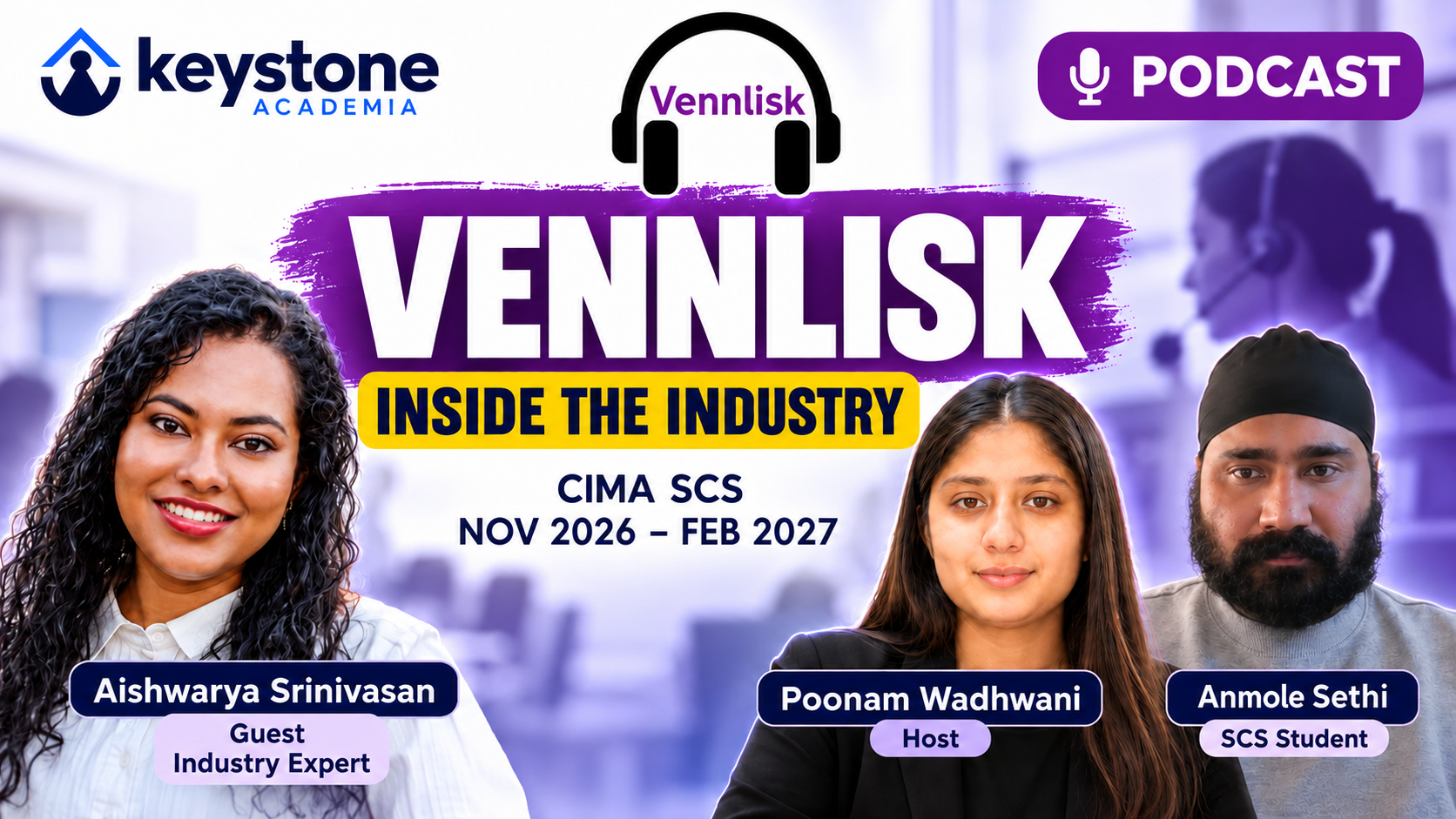
Hosted by Poonam Wadhwani, the discussion features Aishwarya Srinivasan, a finance professional with experience in customer operations and performance reporting, alongside Anmole Sethi, a CIMA SCS student who brings questions from a learner’s perspective.
The conversation explores the practical realities of the industry and connects them to the strategic decisions Vennlisk’s management may need to consider.
Watch the Full Vennlisk Industry Discussion Podcast
CIMA SCS Vennlisk: Inside the Industry | November 2026 and February 2027
In this discussion, we explore Vennlisk’s business model, customer service KPIs, employee retention, AI adoption, cybersecurity, competitive strategy and the role of finance in strategic decision-making.
Free CIMA SCS preparation resources:
- CIMA SCS Preparation and Guidance
- Join Our Free CIMA SCS WhatsApp Community
- Explore the Vennlisk SCS Mini Course
1. Understanding Vennlisk’s Business Model: Why Do Companies Outsource Customer Service?
Vennlisk operates in the outsourced inbound call centre industry. Its clients rely on specialist providers to manage customer enquiries, complaints and service-related interactions.
But why would a business outsource something as important as customer service?
Consider a bank receiving thousands of customer calls every day. Managing these calls internally requires trained employees, supervisors, technology, infrastructure and ongoing investment.
Rather than managing the entire operation itself, the bank may choose to work with an outsourced contact centre provider.
During the podcast, Aishwarya explained that businesses generally outsource customer service for three reasons.
Specialist expertise: Outsourcing providers develop experience in managing customer interactions, handling service requests and monitoring performance.
Operational flexibility: Businesses can access additional customer service capacity without having to build and manage every resource internally.
Cost considerations: Outsourcing may provide a more efficient operating model, depending on the service requirements and contract arrangements.
However, outsourcing also introduces risks.
When a company outsources customer service, it allows another organisation to interact directly with its customers. Poor service can damage the client’s reputation, even when the problem originates with the outsourcing provider.
This creates an important responsibility for Vennlisk.
It must deliver an efficient service while protecting the customer relationships and reputations of its clients.
How could this apply to the CIMA SCS exam?
Suppose Vennlisk is considering a new outsourcing contract.
Students may need to evaluate whether the contract is commercially attractive, whether Vennlisk has sufficient capacity and whether it can maintain the required service quality.
A strong answer should consider profitability, operational capability, client expectations and risks.
This is where knowledge of E3 strategic management, P3 risk management and F3 financial strategy becomes important.
2. Vennlisk Call Centre KPIs: Why Faster Calls Do Not Always Mean Better Performance
One of the most valuable discussions in the podcast focused on how contact centres measure performance.
A call centre needs to answer customer enquiries efficiently. However, focusing too heavily on speed can create unexpected problems.
Imagine an agent who is expected to complete customer calls as quickly as possible.
The agent may rush through the conversation to achieve a lower average handling time.
But if the customer’s problem is not properly resolved, the customer may call again.
The second call increases the total workload, creates frustration and may require another agent to investigate the same issue.
Although the first call was completed quickly, the overall process was inefficient.
This illustrates why Vennlisk’s management should not evaluate performance using a single KPI.
Five important call centre KPIs for Vennlisk
| KPI | What it measures | Why it matters |
|---|---|---|
| Average Handling Time (AHT) | Average time spent handling a customer interaction | Helps assess efficiency, but excessively low targets may encourage rushed calls |
| First Contact Resolution (FCR) | Whether customer issues are resolved during the first interaction | Higher resolution can reduce repeat contacts and improve customer experience |
| Customer Satisfaction (CSAT) | How satisfied customers are with the service | Helps assess service quality and customer outcomes |
| Service Level | How effectively calls are answered within agreed response times | Indicates whether the operation is meeting service expectations |
| Call Abandonment Rate | Percentage of callers who disconnect before reaching an agent | May reveal long waiting times or insufficient capacity |
What should Vennlisk focus on?
The objective should not simply be to reduce call handling time.
Management needs to balance efficiency, customer satisfaction and the cost of delivering the service.
For example, if average handling time decreases but customer complaints increase, management should investigate whether agents are rushing conversations or failing to resolve issues.
A better approach may involve reviewing training, call quality, staffing and performance targets.
CIMA SCS exam application
If an unseen scenario provides conflicting performance indicators, avoid concluding that the business is performing well simply because one measure has improved.
Consider how the KPIs relate to each other and what the results mean for customers, costs and client relationships.
This demonstrates commercial judgement rather than simply explaining performance measures.
3. Employee Training and Retention: A Strategic Challenge for Vennlisk
Customer service remains a people-intensive industry.
Although technology can support agents, experienced employees play an important role in delivering consistent service.
During the podcast, Aishwarya highlighted how experienced agents develop knowledge that goes beyond standard training materials.
They understand client requirements, recognise common customer problems, handle difficult situations and know when an issue needs to be escalated.
When these employees leave, Vennlisk may lose valuable operational knowledge.
Why is employee turnover a concern?
Consider a team that loses several experienced agents within a short period.
The company must recruit replacements and invest time in training them.
New employees may initially take longer to resolve enquiries. Supervisors and experienced colleagues may need to provide additional support.
This can affect productivity, service quality and customer satisfaction.
Employee turnover therefore creates costs beyond recruitment expenses.
It can also affect Vennlisk’s ability to meet client expectations.
The connection between employee retention and financial performance
High employee turnover may result in:
- Increased recruitment and training expenditure.
- Lower productivity during the learning period.
- Loss of experienced operational knowledge.
- Greater pressure on supervisors and existing employees.
- Potential deterioration in customer service performance.
These consequences can eventually affect profitability and client retention.
For Vennlisk, employee retention is not simply an HR issue. It is also an operational, financial and strategic concern.
What should Vennlisk management consider?
Management should investigate why employees leave and identify whether training, career development, workload or other working conditions need improvement.
The business could also strengthen knowledge-sharing arrangements, document important processes and cross-train employees.
These actions may reduce dependence on individual agents and improve operational resilience.
CIMA SCS exam application
If an unseen scenario reports rising employee turnover, avoid recommending higher salaries without first considering the causes.
A stronger response would assess the operational consequences, financial implications and practical measures available to management.
The recommendation should explain how the proposed actions support Vennlisk’s service quality and competitive position.
4. Will AI Replace Call Centre Agents? What It Means for Vennlisk
Artificial intelligence was one of the most important topics discussed in the podcast.
AI is changing how businesses handle customer enquiries, but its impact depends on how the technology is implemented.
Anmole raised a question that many CIMA SCS students may have:
Will AI eventually replace human customer service agents?
Aishwarya explained that the answer is more complicated than a simple yes or no.
Some activities can be automated, while others continue to require human judgement and understanding.
Where could AI help Vennlisk?
AI may support routine customer interactions, such as answering straightforward questions, retrieving information and directing customers to appropriate services.
It may also help agents by providing relevant information during calls or preparing summaries after conversations.
These applications could reduce repetitive work and allow employees to focus on more complicated customer issues.
However, the benefits would depend on the quality of the technology, the data available and how effectively it integrates with existing operations.
Why are human agents still important?
Not every customer problem can be resolved through a standard response.
Some interactions involve complaints, sensitive circumstances, unusual requests or complex decisions.
In these situations, customers may need empathy, careful judgement and reassurance.
Human agents can also recognise when a situation requires escalation or when an automated response is inappropriate.
For Vennlisk, the opportunity may be to combine AI with skilled employees rather than treating technology as a complete replacement for its workforce.
What risks could AI introduce?
Aishwarya discussed the possibility of AI systems recording information incorrectly.
For example, an automated system could misunderstand a number or incorrectly transcribe customer information.
If the error is not identified, it may affect subsequent decisions or customer records.
Other risks include data privacy, cybersecurity, inaccurate responses, implementation costs and excessive dependence on technology.
This means Vennlisk would need suitable controls, human oversight and clear accountability.
Should Vennlisk invest in AI?
The decision should depend on whether the investment creates genuine business value.
Management should consider:
- The activities that could realistically be automated.
- Expected cost savings and productivity improvements.
- Initial investment and ongoing operating costs.
- Potential effects on customer satisfaction.
- Cybersecurity and data protection requirements.
- Employee training and organisational changes.
- Financial returns and implementation risks.
CIMA SCS exam application
An AI investment scenario could require students to combine E3, P3 and F3 knowledge.
E3 helps evaluate whether AI supports the company’s strategy.
P3 helps assess implementation, technology and operational risks.
F3 helps determine whether the investment is financially justified.
A strong recommendation should consider all three perspectives.
5. Vennlisk’s Competitive Strategy: Quality Versus Lower Prices
Competition is another important challenge for outsourced call centre providers.
Some competitors may be able to offer lower prices because of their operating structures, technology or cost base.
This raises an important question for Vennlisk.
Should the company compete primarily on price, or should it focus on delivering a higher-quality service?
During the podcast, Aishwarya explained that businesses should not assume customers will pay more simply because a provider claims to offer better quality.
The value must be demonstrated.
Why might a client choose a more expensive provider?
Consider two outsourcing providers.
One offers a lower contract price but struggles with repeat calls, inconsistent service and customer complaints.
The other charges more but delivers reliable service, experienced agents and stronger customer outcomes.
Although the second provider costs more initially, it may create greater value for the client.
Poor customer service can create additional costs through repeat enquiries, complaints, lost customers and reputational damage.
Therefore, the lowest price does not always represent the best overall value.
How can Vennlisk demonstrate its value?
Vennlisk could use performance information to demonstrate the benefits of its service.
Relevant measures may include first contact resolution, customer satisfaction, complaint trends, operational reliability and the quality of client relationships.
The company should also understand which service features its clients value most.
A quality-led strategy will be difficult to sustain if clients cannot see a meaningful difference between Vennlisk and lower-cost competitors.
CIMA SCS exam application
If Vennlisk is considering reducing prices to win a contract, students should evaluate the likely effects on revenue, margins, service standards and competitive positioning.
A recommendation to reduce prices should be supported by financial and commercial analysis.
Equally, recommending a premium price requires evidence that clients will recognise and pay for the additional value.
6. Cybersecurity and Data Protection Risks in Vennlisk
Outsourced call centres may handle large volumes of personal and commercially sensitive information.
Depending on the client and service provided, this could include customer contact details, account information and financial data.
A security incident could therefore have consequences for Vennlisk, its clients and their customers.
During the podcast, the discussion explored the importance of protecting information and preparing for operational disruption.
What could happen if Vennlisk experiences a data breach?
A serious incident may result in service interruptions, investigation costs, contractual disputes and reputational damage.
Clients may also question whether Vennlisk has adequate systems and controls to protect their customers.
This could affect future contracts and the company’s competitive position.
How should Vennlisk manage these risks?
Management should consider preventative controls alongside arrangements for responding to incidents.
Important areas include access controls, employee awareness, monitoring, incident response procedures and business continuity planning.
The company should also understand its contractual and legal obligations relating to customer information.
Testing recovery arrangements is important because a plan that has never been tested may not work effectively during a real incident.
CIMA SCS exam application
If the unseen material introduces a cybersecurity incident, students should consider both immediate and longer-term actions.
Immediate priorities may include containing the incident, restoring critical services, investigating the cause and communicating appropriately with affected parties.
Longer-term actions may include strengthening controls, reviewing responsibilities and improving operational resilience.
The Board needs to understand the financial, operational and reputational implications.
7. Three Strategic Priorities for Vennlisk’s Board
Towards the end of the podcast, Poonam asked Aishwarya to identify the most important strategic priorities for Vennlisk.
Three themes emerged from the discussion.
Priority 1: Protect Vennlisk’s service quality and competitive position
Vennlisk should continue demonstrating the value it provides to clients.
Reliable customer service, experienced employees and strong operational performance can help distinguish the company from competitors.
However, management must ensure that the benefits of its service justify the associated costs.
Priority 2: Adopt AI and technology in a controlled way
Technology could help Vennlisk improve efficiency and respond to industry changes.
But investment should be guided by business needs and financial analysis.
Management should identify suitable applications, evaluate risks and measure whether the technology improves performance.
Priority 3: Strengthen people and operational resilience
Vennlisk depends on capable employees, reliable systems and secure information.
Employee development, knowledge retention, cybersecurity and business continuity are therefore important to long-term performance.
These priorities are interconnected.
Maintaining high-quality service requires skilled employees and dependable operations. Improving efficiency may require technological investment, but technology must be introduced without undermining customer outcomes.
The Board needs to balance these competing demands.
8. How to Apply Vennlisk Industry Analysis in the CIMA SCS Exam
Understanding the industry is useful, but the exam tests whether you can apply that understanding to business situations.
Candidates take the role of a senior manager in Vennlisk’s finance function, advising the Board on strategic matters.
Your answers should therefore go beyond explaining theory.
You need to evaluate issues, identify implications and recommend appropriate actions.
Example: Vennlisk is considering automating customer calls
A descriptive answer might explain that AI can reduce costs and improve efficiency.
A stronger SCS answer would evaluate whether automation is suitable for Vennlisk.
It would consider which calls could be automated, whether service quality might be affected, what controls would be necessary and whether the financial benefits justify the investment.
It would then make a recommendation based on those factors.
Example: Customer complaints are increasing
A weak answer might simply recommend more employee training.
A stronger answer would investigate the possible causes.
Have employee turnover rates increased? Has first contact resolution declined? Are agents under pressure to complete calls quickly? Has the company introduced new systems?
The recommendation should address the underlying problem rather than assuming the cause.
A practical approach to writing Vennlisk SCS answers
For many strategic tasks, a useful approach is to:
- Identify the issue presented in the unseen information.
- Explain its relevance to Vennlisk, using the company’s business model and circumstances.
- Evaluate the consequences, including financial, operational, strategic and risk implications.
- Make a recommendation that addresses the issue and explains the reasoning.
Students should also demonstrate the relevant technical, business, people, leadership and digital skills where appropriate.
The goal is not to include every possible point. It is to provide a relevant, balanced and commercially sensible response to the task.
9. How Keystone Academia Students Are Preparing for Vennlisk
During the podcast, Anmole discussed his experience preparing for the Strategic Case Study examination.
He explained that preparation involved revisiting E3, P3 and F3 knowledge and applying it to Vennlisk.
Students were also analysing the company’s business environment, strategy, risks and governance.
Tools such as SWOT and PESTEL analysis can help organise this understanding.
However, studying the pre-seen is only one part of preparation.
Students also need to practise answering unfamiliar questions, managing their time and developing recommendations.
Mock examinations are particularly useful because they help students identify whether they can apply their knowledge under exam conditions.
For the November 2026 and February 2027 examinations, preparation should combine:
- Understanding Vennlisk’s business model and industry.
- Revising relevant E3, P3 and F3 concepts.
- Analysing the company’s strategic opportunities and risks.
- Practising unseen scenarios and Board-level recommendations.
- Completing timed mock exams and reviewing feedback.
The most effective preparation focuses on developing judgement, not memorising model answers.
10. Frequently Asked Questions About Vennlisk CIMA SCS
What is Vennlisk in the CIMA SCS November 2026 exam?
Vennlisk is the fictional company featured in the CIMA Strategic Case Study pre-seen for November 2026 and February 2027. It operates in the outsourced inbound call centre industry.
Why is Vennlisk industry analysis important for CIMA SCS?
Industry analysis helps students understand how the company creates value, what risks it faces and how strategic decisions may affect customers, employees and financial performance.
What are the main strategic challenges facing Vennlisk?
Important areas for study include service quality, competition, employee retention, AI adoption, cybersecurity, operational resilience and investment decisions. These are preparation themes rather than predictions of examination questions.
How can AI affect Vennlisk’s business model?
AI could automate routine customer interactions, support human agents and improve productivity. However, management would need to evaluate implementation costs, data protection, service quality and operational risks.
Which call centre KPIs are important for Vennlisk?
Average handling time, first contact resolution, customer satisfaction, service level and call abandonment rate are useful measures. Students should understand how these indicators interact rather than assessing each one in isolation.
How does employee turnover affect Vennlisk?
Employee turnover can increase recruitment and training costs, reduce operational knowledge and potentially affect productivity and customer satisfaction.
How should students prepare for the Vennlisk SCS exam?
Students should understand the pre-seen, revise E3, P3 and F3, develop industry knowledge and practise applying that knowledge through unseen scenarios and timed mock examinations.
What is the role of the candidate in the Vennlisk SCS exam?
Candidates act as a senior manager in Vennlisk’s finance function, advising the Board on strategic matters and special projects.
Is Vennlisk the pre-seen company for February 2027?
Yes. Vennlisk is the pre-seen company for both the November 2026 and February 2027 CIMA Strategic Case Study examinations.
Final Thoughts: Think Like a Senior Finance Manager
The most important lesson from this Vennlisk industry discussion is that business decisions involve competing priorities.
Reducing costs may improve margins but could affect service quality.
AI may increase efficiency but also introduce new risks.
Employee training requires investment, but losing experienced staff may create even greater costs.
And improving one KPI does not necessarily mean the overall business is performing better.
In the CIMA Strategic Case Study exam, you are expected to consider these relationships and advise management accordingly.
A strong candidate does not simply explain what a company could do. They evaluate the alternatives, understand the consequences and recommend an appropriate course of action.
That is why practical industry knowledge can make a meaningful difference to your preparation.
Preparing for CIMA SCS November 2026 or February 2027? Take the Next Step
You have now explored how Vennlisk’s industry works, the challenges it faces and how these issues connect to E3, P3 and F3.
The next step is learning how to turn this knowledge into a strong exam answer.
At Keystone Academia, our CIMA SCS preparation focuses on understanding the pre-seen, applying technical knowledge, developing strategic recommendations and practising under exam conditions.
Whether you are preparing for November 2026 or February 2027, you can start with our free resources.
Explore our CIMA SCS preparation programme
Find out more about our structured preparation, tutor guidance and mock exam support.
Explore CIMA SCS Preparation at Keystone Academia
Start with our Vennlisk SCS mini course
Build your understanding of the company and begin connecting the pre-seen to your technical knowledge.
Access the Vennlisk SCS Mini Course
Join our free CIMA SCS WhatsApp community
Connect with other candidates, follow preparation updates and take part in study discussions.
Join the Free CIMA SCS WhatsApp Community
And if you have not watched the podcast yet, hear the full industry discussion with Aishwarya, Poonam and Anmole.
Watch the Vennlisk Industry Discussion Podcast on YouTube
Don’t just memorise the Vennlisk pre-seen. Learn how to analyse it, apply it and make recommendations with confidence.
Keystone Academia — CIMA Case Study Preparation
This article is based on Keystone Academia’s Vennlisk industry discussion podcast and is intended for educational purposes. The scenarios and strategic recommendations discussed are examples of exam application, not predictions of actual examination questions.