
Can an Indian Chartered Accountant pursue CIMA after years of working in finance? And is it possible to pass the CIMA Strategic Case Study exam in just three months while managing a full-time career?
For Koushik Sundaram, the answer was yes.
Koushik , an Indian Chartered Accountant and experienced Financial Planning and Analysis (FP&A) professional, passed the CIMA Strategic Case Study (SCS) examination in August 2026.
What makes his achievement particularly interesting is that he returned to professional studies after approximately 15 years. He was already established in his finance career, had significant professional responsibilities and had to adjust to a different examination format.
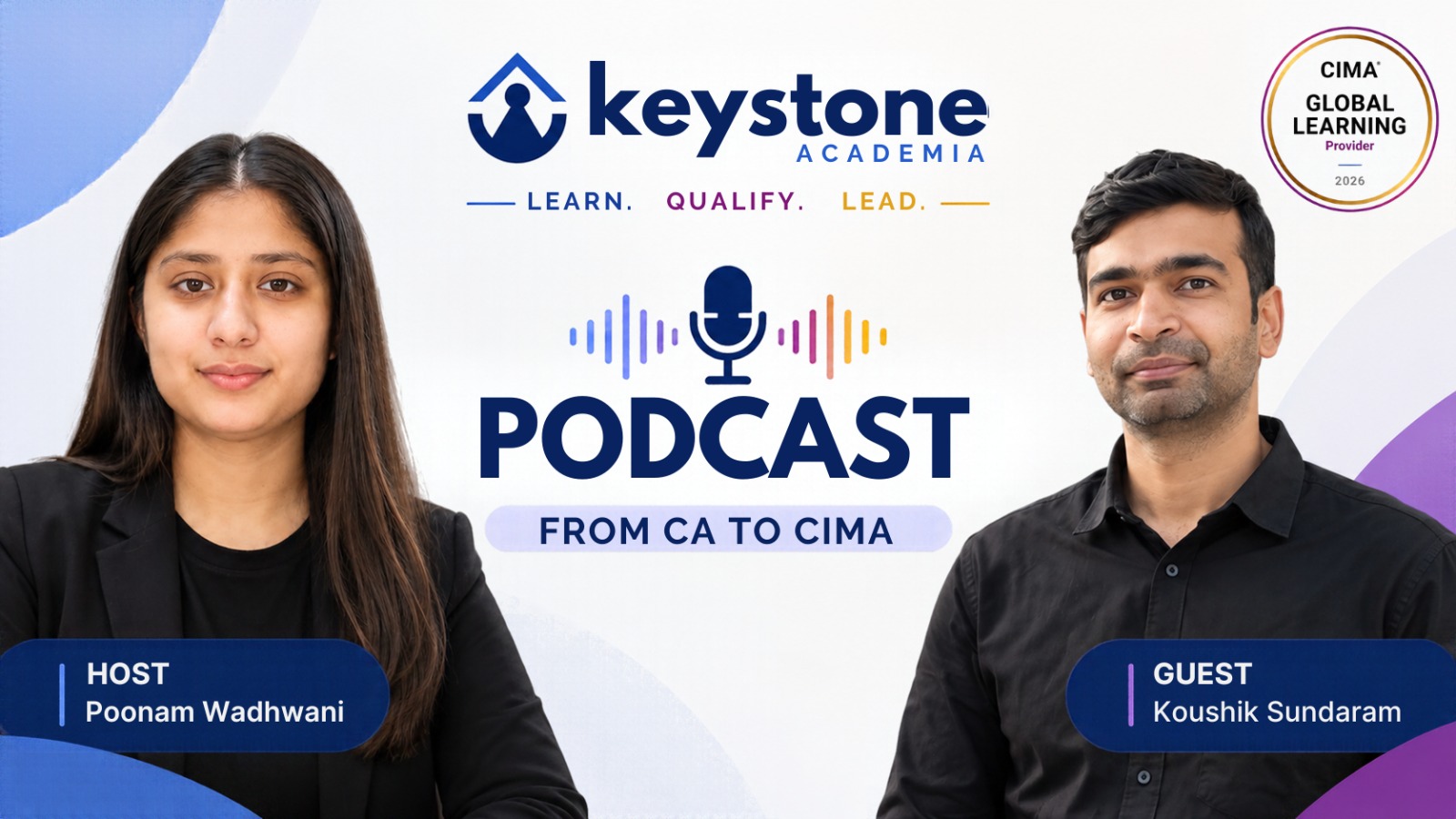
In a recent Keystone Academia Podcast conversation with Poonam Wadhwani, Koushik discussed why he chose CIMA after CA, the challenges of returning to studies, the importance of mock exams and the skills finance professionals need to progress into strategic leadership roles.
His experience offers useful lessons for both qualified Chartered Accountants considering CIMA and students preparing for their upcoming CIMA case study examinations.
Watch the full podcast with Koushik Sundaram:
Why Would an Indian Chartered Accountant Pursue CIMA?
For many Indian Chartered Accountants, completing the ICAI qualification represents a major professional achievement.
The qualification provides a strong foundation in accounting, auditing, taxation, financial reporting and regulatory compliance.
But as finance professionals progress through their careers, their responsibilities can extend beyond traditional accounting functions.
They may become involved in:
- Financial planning and analysis
- Business strategy and commercial decision-making
- Investment evaluation and risk management
- Business partnering and performance management
- Advising senior management and boards
- International finance and leadership opportunities
Koushik had spent close to a decade working in FP&A when he decided to pursue CIMA.
His decision was influenced by two main considerations.
1. International Career Opportunities
Koushik was interested in the international recognition of CIMA and the potential opportunities associated with the qualification.
As he explained during the conversation, professional qualifications can be an important consideration for finance professionals who want to explore careers outside their home country.
CIMA’s international presence and its association with the CGMA designation were among the reasons he found the qualification attractive.
However, international recognition does not automatically guarantee employment, professional licensing or equivalence with a country’s local accounting designation. Those requirements depend on the employer, jurisdiction and role.
2. Developing Strategic and Commercial Skills
Koushik also wanted to strengthen skills that complemented his existing experience in FP&A.
He identified areas such as:
- Strategic decision-making
- Commercial awareness
- Enterprise risk management
- Operational strategy
- Business performance
- Understanding organisational challenges beyond finance
For him, CIMA offered an opportunity to connect financial knowledge with broader business decisions.
This is particularly relevant for professionals who want to move from preparing financial information to influencing how organisations use that information.
CA vs CIMA: How Do the Qualifications Complement Each Other?
A common question among finance professionals is whether pursuing CIMA makes sense after completing CA.
Koushik’s experience highlights how the qualifications can complement each other.
| Indian CA background | CIMA strategic focus |
|---|---|
| Financial accounting and reporting | Strategic business decision-making |
| Audit and assurance | Enterprise risk and governance |
| Taxation and compliance | Commercial and operational strategy |
| Financial controls | Performance management |
| Financial analysis | Strategic evaluation and recommendations |
These are broad areas of emphasis rather than exclusive differences. Both qualifications can develop overlapping competencies.
Koushik’s central argument was that technical accounting knowledge remains important, but experienced finance professionals also need to understand the bigger picture.
An accountant may explain what happened financially during the previous year.
A strategic finance professional must also help answer:
What should the business do next, and why?
That requires financial knowledge, commercial judgement, communication and an understanding of the organisation’s operating environment.
For Koushik, combining CA, CIMA and practical experience provided a broader perspective on business decision-making.
How Can an Indian CA Become CIMA Qualified Through a Fast-Track Route?
One of the most important parts of Koushik’s journey was discovering that he might not need to complete the entire CIMA examination pathway from the beginning.
During the podcast, he explained that Keystone Academia helped him understand an accelerated pathway available to eligible qualified professionals.
This made the qualification more accessible from both a study and financial perspective.
What Is the CIMA GPAP Route?
The CIMA Global Professional Accountant Programme (GPAP) is an accelerated pathway for eligible accounting professionals.
Depending on CIMA’s current eligibility requirements, qualified members of recognised professional accounting bodies, including eligible ICAI members, may be able to enter through a route that requires passing the Strategic Case Study examination rather than completing the full sequence of examinations.
For someone who has already completed a demanding professional accounting qualification, this can significantly reduce the number of additional examinations required.
However, eligibility must be confirmed individually. The applicable route, fees, membership requirements and exemptions should always be checked against CIMA’s current rules.
How Did Koushik Discover This Route?
Koushik explained that he had considered CIMA previously but had not been aware of the accelerated option available to him.
After learning about the pathway through Keystone Academia, he reconsidered the opportunity.
The reduced examination burden and associated cost considerations played an important role in his decision.
For other ICAI-qualified professionals, the lesson is straightforward:
Before deciding that CIMA will take too much time or cost too much, first check whether you qualify for an accelerated pathway.
Explore the CA to CIMA pathway:
How Did Koushik Pass CIMA SCS in Just 3 Months?
Koushik passed the August 2026 Strategic Case Study examination after approximately three months of preparation.
He did this while continuing his professional career and managing personal commitments.
His experience offers several lessons for CIMA SCS students.
1. Understand That CIMA SCS Is Different From Traditional Exams
Koushik already had extensive accounting knowledge and professional experience.
However, the Strategic Case Study required a different approach.
Instead of simply recalling concepts or completing calculations, candidates must analyse business situations, apply relevant knowledge and make appropriate recommendations.
Koushik found this particularly interesting because it required him to think from the perspective of senior management.
He described the case study as an opportunity to consider the wider responsibilities of business leaders, rather than focusing exclusively on finance.
For students, this means technical knowledge alone is not enough.
You must understand how that knowledge helps an organisation make decisions.
2. Time Management Was His Biggest Challenge
Interestingly, Koushik did not identify understanding the technical concepts as his greatest difficulty.
His biggest challenge was finishing answers within the available examination time.
He explained that during his earlier professional examinations, he had often been able to finish comfortably before the deadline.
The CIMA Strategic Case Study was different.
Even when he understood the question and knew what he wanted to write, he sometimes struggled to complete every point.
He recalled that in his final examination, he still had a few sentences he wanted to add when time ran out.
This is an important lesson for students preparing for CIMA SCS.
Knowing the answer and being able to write it within the available time are two different skills.
3. Mock Exams Made a Significant Difference
One of the strongest messages from the podcast concerned mock examinations.
Koushik openly discussed his initial mock exam performance.
His early results were well below the standard he wanted to achieve.
However, he continued practising.
As he completed more mock examinations, he became more familiar with the required approach and improved his performance.
He emphasised that mock exams were essential to his preparation.
Why?
Because mocks help students practise the actual skills required during the examination:
- Reading and interpreting unfamiliar scenarios
- Identifying the requirements of a task
- Selecting relevant technical knowledge
- Applying concepts to the case company
- Structuring professional recommendations
- Managing time under examination conditions
What Should CIMA SCS Students Learn From This?
Do not wait until you feel completely prepared before attempting a mock examination.
Start practising early enough to identify your weaknesses.
A practical approach is to complete a mock under timed conditions, review the feedback, identify areas for improvement and apply those lessons in the next attempt.
The objective is not simply to complete more mocks.
It is to improve the quality, relevance and efficiency of your answers.
Can You Prepare for CIMA SCS While Working Full-Time?
Yes, Koushik’s experience demonstrates that it is possible.
However, he did not follow a rigid daily timetable.
During the podcast, he explained that he had to balance work with other personal responsibilities.
Rather than viewing studying as an additional burden, he approached it as an intellectually engaging activity.
He was interested in the material and enjoyed the challenge of applying strategic concepts to business situations.
That positive approach helped him remain committed to his preparation.
What Can Working Professionals Learn?
There is no single study schedule that works for everyone.
Some candidates may prefer early-morning revision. Others may study after work or use weekends for longer practice sessions.
What matters is finding a sustainable approach that allows enough time for learning, application and timed mock practice.
Koushik also highlighted the importance of having a supportive manager.
For working professionals, reasonable flexibility around examination preparation and leave can make a meaningful difference.
His experience does not mean that every candidate can pass in three months. Preparation time depends on existing knowledge, work commitments, examination familiarity and individual circumstances.
But it does show that returning to professional education after many years is possible.
Why FP&A Professionals Should Consider CIMA
Another important part of the conversation focused on the changing role of finance.
Koushik reflected on how finance careers have evolved since he first entered the profession.
Traditionally, many Chartered Accountants focused on areas such as:
- Audit
- Taxation
- Financial accounting
- Controllership
- Treasury
These functions remain essential.
However, Koushik discussed how FP&A and business finance have become increasingly important in helping organizations plan for the future.
From Financial Reporting to Business Decision-Making
Traditional financial reporting helps organisations understand their historical performance.
FP&A takes that information further.
For example, instead of only reporting that operating costs increased by 12%, an FP&A professional might investigate:
- What caused the increase?
- Is it temporary or structural?
- How will it affect future profitability?
- What actions could management take?
- What are the risks associated with those actions?
This is where finance becomes more directly involved in business strategy.
Koushik also discussed how FP&A experience can support progression into areas such as investor reporting, IPO readiness and broader finance leadership responsibilities.
These are potential career directions, not guaranteed outcomes of completing CIMA.
Why Strategic Thinking Matters
A finance professional who wants to influence senior management must do more than present accurate numbers.
They must be able to interpret information, explain business implications and recommend practical actions.
This combination of financial knowledge and strategic judgement is one reason Koushik found CIMA relevant to his career.
Technical Knowledge Alone Is Not Enough: The Importance of People Skills
One of the most valuable discussions in the podcast was not about CIMA examinations at all.
It was about working with people.
Koushik explained that many tasks appear straightforward when studying accounting.
In an examination, the information needed to prepare financial statements or complete a calculation is usually provided.
In a real organisation, information often needs to be collected from multiple departments and individuals.
Each department may have different priorities, responsibilities and deadlines.
This makes communication and relationship management essential.
What Skills Should Finance Professionals Develop?
Alongside technical competence, finance professionals benefit from developing:
- Communication skills
- Stakeholder management
- Collaboration across departments
- Professional judgement
- The ability to influence decisions
- Resilience and adaptability
Koushik advised younger professionals to remain curious, explore different opportunities and build positive professional relationships.
He also emphasised the importance of maintaining appropriate boundaries at work.
His broader message was that long-term career growth depends not only on qualifications but also on how effectively professionals work with others.
AI, Power BI and the Future of Finance Careers
The conversation also explored how artificial intelligence and automation are changing finance.
Koushik believes that finance professionals will increasingly need to combine analytical ability with technological awareness.
He discussed the growing relevance of tools such as Power BI and AI-supported financial analysis.
What Could AI Change in FP&A?
AI and automation can support activities such as:
- Financial forecasting
- Scenario analysis
- Data processing
- Management reporting
- Visualisation of business performance
- Identifying patterns in financial information
However, Koushik also warned against relying on AI outputs without sufficient review.
He specifically discussed the risk of inaccurate or fabricated AI-generated information.
Finance professionals need to understand the assumptions behind analytical outputs and assess whether the results are reliable.
This is especially important when information is being used to advise senior management or support major business decisions.
The Future Finance Professional
The value of a finance professional may increasingly depend on their ability to combine three capabilities:
Financial expertise + Technology awareness + Business judgement
Technology can help generate information.
But professionals still need to interpret it, challenge assumptions, explain the implications and exercise judgement.
This is another reason why strategic thinking and communication skills remain important.
Is CIMA Worth It After CA?
Koushik’s answer was not that every Chartered Accountant should pursue CIMA.
In fact, he made an important distinction.
The value of an additional qualification depends on your existing responsibilities and future career ambitions.
For someone primarily interested in compliance, taxation or traditional controllership, CIMA may not necessarily be the most relevant next step.
However, professionals interested in FP&A, business partnering, strategic finance and management-oriented roles may find the qualification more closely aligned with their goals.
Before deciding, consider these questions:
- What type of finance role do I want in the next five years?
- Do I want to move towards business strategy or financial leadership?
- Will CIMA help me develop skills that complement my existing qualification?
- Am I eligible for an accelerated CIMA pathway?
- Can I realistically commit the time needed for examination preparation?
A qualification should support your career direction rather than simply add another credential to your CV.
What Support Did Keystone Academia Provide?
During the podcast, Koushik discussed how Keystone Academia contributed to his decision to pursue CIMA.
He explained that discovering the accelerated pathway was an important turning point.
He also appreciated the guidance he received while considering the qualification and preparing for the examination.
His experience reflects the value of understanding the available routes before committing to professional studies.
At Keystone Academia, we support students and qualified finance professionals through CIMA pathway guidance, structured learning, case study preparation and mock examination practice.
Our aim is to help candidates understand their options and prepare with a clear plan.
Frequently Asked Questions About CIMA After CA
1. Can an Indian Chartered Accountant pursue CIMA?
Yes. ICAI-qualified Chartered Accountants can pursue CIMA. Eligible professionals may also qualify for an accelerated pathway, depending on CIMA’s current entry requirements.
2. How many CIMA exams does an Indian CA need to pass?
The number of examinations depends on the pathway and exemptions approved by CIMA. Some eligible professionals may qualify for a route requiring the Strategic Case Study examination. Eligibility should be confirmed before enrolment.
3. Can I complete CIMA in 3 months after CA?
Koushik Sundaram passed the Strategic Case Study examination after approximately three months of preparation. However, his experience should not be treated as a standard completion timeline. The duration depends on eligibility, preparation, professional experience and individual circumstances.
4. Is CIMA useful for FP&A professionals?
CIMA can be relevant for FP&A professionals who want to strengthen their strategic, commercial, risk management and business decision-making skills.
5. Is CIMA better than CA for finance leadership?
Neither qualification is universally better. They have different areas of emphasis, and their relevance depends on the individual’s career goals. Combining an accounting qualification with strategic finance skills and professional experience can be valuable for certain leadership roles.
6. How important are mock exams for CIMA SCS?
Mock exams are an important preparation tool because they help students practise scenario analysis, answer structure, case application and time management. Koushik identified repeated mock practice as a major factor in improving his exam readiness.
7. Can working professionals prepare for CIMA SCS?
Yes. Working professionals can prepare alongside employment, although they need a realistic study plan. Koushik balanced full-time work and personal commitments while preparing for his August 2026 examination.
8. Does CIMA guarantee international career opportunities?
No. CIMA is internationally recognised, but employment opportunities depend on experience, skills, employer requirements, immigration rules and local professional regulations.
Watch the Full Podcast: Koushik Sundaram’s CA to CIMA Journey
Koushik’s experience offers a useful reminder that professional development does not have to stop once you become established in your career.
After approximately 15 years away from professional examinations, he returned to studying, prepared for a different assessment format and successfully passed CIMA SCS in August 2026.
His journey also highlights three important lessons:
First, choose qualifications that align with your career ambitions.
Second, practical examination preparation matters. Understanding concepts is important, but applying them under timed conditions is equally essential.
Third, long-term success in finance requires more than technical knowledge. Strategic thinking, communication, adaptability and professional judgement all matter.
Watch the complete conversation with Koushik Sundaram and Poonam Wadhwani on the Keystone Academia Podcast:
Are You an Indian CA Considering CIMA?
Explore the CIMA accelerated pathway for eligible qualified professionals.
CA to CIMA GPAP pathway:
Preparing for the CIMA November 2026 or February 2027 Case Study Exams?
Join our free student communities for exam discussions, revision guidance and case study resources.
CIMA OCS – Tendra Tents
https://chat.whatsapp.com/GkJVkYiR0TzFL9JZXqhiTP?s=sw&p=i&mlu=4&ilr=4
CIMA MCS – Wuudbreak
https://chat.whatsapp.com/GiFJUGbQRNADkEeQ544hx5?s=sw&p=i&mlu=4&ilr=4
CIMA SCS – Vennlisk
https://chat.whatsapp.com/JLy3GBvLVJhJ9oUKfOMmHC?s=sw&p=i&mlu=4&ilr=4
You can also register for our free CIMA SCS Vennlisk mini course:
https://learn.keystoneacademia.com/course/cima-scs-nov-26-mini-course
About Keystone Academia
Keystone Academia is a CIMA learning provider supporting aspiring management accountants, case study students and experienced finance professionals pursuing CIMA and the CGMA designation.
Learn more at https://keystoneacademia.com/