

Why Vennlisk’s Board Matters for the CIMA SCS
Corporate governance can sometimes feel like a theoretical topic.
For Vennlisk, it shouldn’t.
Remember the candidate’s role in the case:
You are a senior manager in Vennlisk’s finance function who reports directly to the Board and advises on special projects and strategic matters.
So if the unseen introduces an AI investment, acquisition, major risk, financing decision, client issue or strategic project, you may effectively be advising these directors.
Understanding who sits on Vennlisk’s Board and what they are responsible for can therefore make your answers much more applied.
Join our Free SCS Mini Course:
https://learn.keystoneacademia.com/course/cima-scs-nov-26-mini-course
Register for the free live session:
Keystone Academia – CIMA SCS Registration
Join our CIMA SCS WhatsApp community:
Join the Keystone Academia CIMA SCS WhatsApp Community
Vennlisk’s Board Structure
Vennlisk has a combination of executive and non-executive directors.
Its Board includes:
| Director | Position |
| Murat Mutlu | Non-Executive Chair |
| Chen Yue | Chief Executive Officer |
| Farrukh Jamil | Human Resources Director |
| Dr Maria Chandler | Operations Director |
| Tshepo Batane | Chief Financial Officer |
| Noor Ebbini | Marketing Director |
| Kyle Keimer | Senior Independent Director |
| Mirjana Churlin | Independent Non-Executive Director |
| Alaor Leite | Independent Non-Executive Director |
The Board therefore brings together executives responsible for running Vennlisk with non-executive directors who can provide independent oversight and challenge.
Murat Mutlu — Non-Executive Chair
Murat had a successful legal career specialising in contract law and held senior positions at one of Westland’s largest law firms. He also served as managing partner before retiring.
He joined Vennlisk’s Board as Non-Executive Chair in 2023.
Why could his background matter?
Vennlisk operates through contractual relationships with clients.
ANALYSIS: Murat’s legal and contract-law experience could therefore be valuable when the Board considers issues involving:
- client contracts,
- major commercial agreements,
- legal exposure,
- governance,
- or significant strategic transactions.
But remember: this is our interpretation of his expertise, not a statement in the pre-seen that he personally manages Vennlisk’s contracts.
Chen Yue — Chief Executive Officer
Chen has an engineering background specialising in telecommunications.
She previously worked in research and development and joined Vennlisk as Head of Network Administration in 2011. She joined the Board in 2018 and became CEO in 2023.
Why is this interesting?
Telecommunications are fundamental to Vennlisk’s business.
Vennlisk also faces significant technological developments, including AI.
ANALYSIS: Chen’s technical background may therefore help the Board understand major technology and telecommunications issues.
However, as CEO, her role is broader than technology. She must lead the organisation as a whole.
Farrukh Jamil — Human Resources Director
Farrukh has professional HR experience, an MBA and previously served as HR Director of a major quoted car manufacturer.
His Vennlisk responsibilities include:
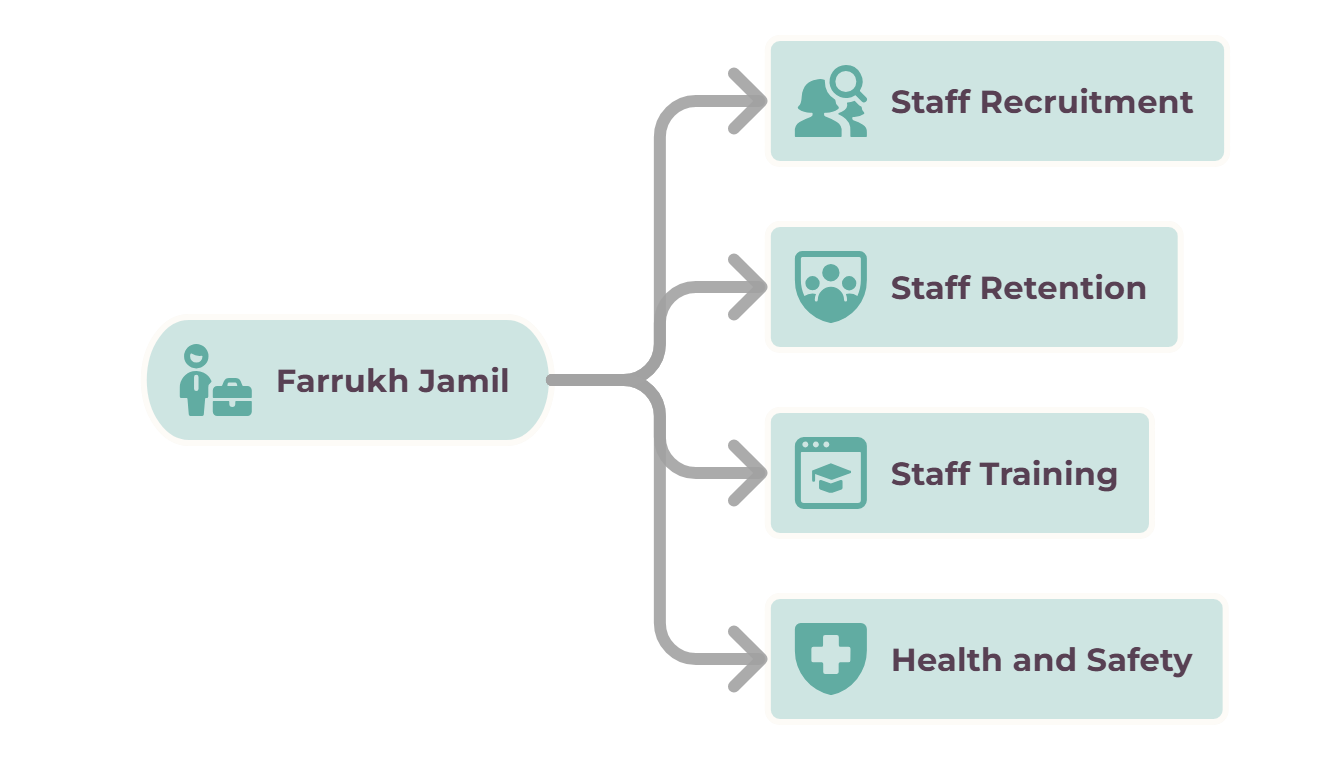
This is highly relevant because Vennlisk depends heavily on its 5,000 agents.
Employee retention, training, motivation and welfare can all affect service quality.
Exam application
If an unseen introduces:
employee resistance to AI,
high staff turnover,
recruitment problems,
health and safety concerns,
or a major training requirement,
Farrukh’s responsibilities become directly relevant.
Dr Maria Chandler — Operations Director
Maria has a particularly relevant technical background.
Her doctorate concerned the application of queuing theory to customer-service optimisation, and she previously worked for Westland Telecommunications.
Her responsibilities at Vennlisk include:
- call-centre operations
- software development
and
- sustainability.
Why does this matter?
Maria could potentially be central to strategic developments involving:
- AI implementation,
- call-centre capacity,
- technology,
- service performance,
- operational efficiency,
- and sustainability.
The pre-seen also specifically states that the Operations Director has oversight responsibility for sustainability issues and brings concerns to the Board.
Tshepo Batane — Chief Financial Officer
Tshepo is a professionally qualified accountant with experience across retail and service businesses.
His responsibilities include:
- financial reporting
- management accounting
and
- treasury.
For SCS students, his role is especially relevant.
A major strategic proposal should rarely be evaluated only from an operational perspective.
The CFO would need to consider issues such as:
- investment cost
- cash flows
- financing
- financial risk
- profitability
and
- shareholder value.
This becomes particularly important if Vennlisk considers a major AI project, acquisition or financing decision.
Noor Ebbini — Marketing Director
Noor joined Vennlisk as a management trainee and progressed through the organisation before becoming Marketing Director in 2024.
Her responsibilities include:
- marketing
- client liaison
and
- public relations.
- Strategic importance
Remember that Vennlisk’s agents effectively interact with callers on behalf of its clients.
Client relationships are therefore critical.
If Vennlisk experiences:
a service-quality failure,
a major client complaint,
a privacy incident,
or reputational damage,
the Marketing Director’s responsibilities could become particularly important.
Vennlisk’s Non-Executive Directors
Vennlisk also has independent non-executive directors.
Kyle Keimer — Senior Independent Director
Kyle spent much of his career in government service and was involved in efficiency measures within the Westlandian Health Service that reduced costs while improving patient care.
That combination is interesting for Vennlisk because it reflects a familiar strategic challenge:
How do you improve efficiency without damaging service quality?
Mirjana Churlin — Independent Non-Executive Director
Mirjana’s career includes teaching mathematics, serving as a headteacher and working as an Inspector of Schools.
She also advises the Westlandian Education Department on mathematics education.
ANALYSIS: Her background may provide useful experience in education, leadership and oversight.
This could potentially be relevant to a company where employee training and development are strategically important.
Alaor Leite — Independent Non-Executive Director
Alaor has held senior finance positions in manufacturing businesses and previously served as Finance Director of a major quoted manufacturer.
His finance background could be particularly useful when scrutinising:
financial reporting,
major investments,
financing,
risk,
and other financially significant Board proposals.
Vennlisk’s Four Board Committees
The pre-seen identifies four Board committees:
Audit
Risk and Sustainability
Remuneration
Nomination.
These committees should not simply be memorised.
Students should understand why they could matter in a scenario.
1. Audit Committee
The Audit Committee has particular relevance to:
financial reporting,
internal controls,
internal audit,
and assurance.
Importantly, Vennlisk’s Chief Internal Auditor reports to the convener of the Audit Committee.
Why is that useful?
This reporting relationship can support the independence of internal audit from executive management.
If an unseen reveals a control weakness, fraud concern or serious governance failure, internal audit and the Audit Committee could become important.
2. Risk and Sustainability Committee
Vennlisk has a dedicated Risk and Sustainability Committee.
The Board receives regular sustainability reports from this committee.
This is particularly relevant because Vennlisk faces principal risks involving:
employees,
privacy,
telecommunications,
health and safety,
and service quality.
It also has sustainability objectives concerning areas such as renewable electricity, waste and staff commuting.
Exam application
A significant AI project could potentially create new:
privacy,
technology,
employee,
cyber,
and implementation risks.
The Risk and Sustainability Committee could therefore have an important oversight role.
3. Remuneration Committee
The Remuneration Committee is part of Vennlisk’s governance structure.
TECHNICAL KNOWLEDGE
A remuneration committee generally helps ensure that senior executive reward arrangements are appropriately governed and aligned with organisational objectives.
Vennlisk application
A useful exam issue could arise if incentives encourage inappropriate behaviour.
For example, rewarding management purely for short-term cost reduction could create pressure to:
reduce training,
cut staffing,
or prioritise efficiency over service quality.
That could conflict with Vennlisk’s longer-term interests.
4. Nomination Committee
Vennlisk also has a Nomination Committee.
TECHNICAL KNOWLEDGE
Nomination committees typically support appropriate Board appointments, succession planning and consideration of Board composition.
Vennlisk application
As Vennlisk’s strategy evolves, the Board should consider whether it continues to have the right balance of:
skills
experience
independence
and
diversity of perspective.
For example, increasing dependence on AI and digital technologies could influence the skills the Board needs in future.
Governance and Vennlisk’s Values
Vennlisk’s stated values include:
Integrity
Excellence
Innovation
and
Work environment.
These are useful when evaluating Board decisions.
Imagine management proposes aggressive automation that substantially reduces costs.
The Board should not ask only:
How much money will this save?
It should also ask:
Will service quality remain excellent?
Is the treatment of employees consistent with Vennlisk’s work-environment values?
Are data and privacy being handled with integrity?
Does the technology genuinely improve customer outcomes?
Governance therefore connects directly to strategy.
AI Could Become a Major Governance Issue
Vennlisk is evaluating artificial intelligence.
AI should not be treated simply as an operational technology decision.
A major AI project could involve:
Operations — implementation and software
HR — employee impact and training
Finance — investment and financial returns
Marketing — client expectations and reputation
Risk and Sustainability Committee — risk oversight
Board — strategic approval and accountability.
Key lesson
Major strategic issues rarely belong to only one director.
Strong governance requires cross-functional oversight.
What Should the Board Ask Before Approving a Major Project?
Whether Vennlisk is considering AI, an acquisition or another major strategic investment, the Board should ask questions such as:
- Does the proposal support Vennlisk’s strategy?
- What financial return is expected?
- What are the major risks?
- How will employees and clients be affected?
- Who is accountable for implementation?
- What controls are required?
- How will performance be monitored?
- What happens if the project fails?
- Does the proposal support long-term shareholder value?
These questions turn governance theory into Board-level SCS advice.
Possible SCS Governance Scenarios
Governance could become relevant if the unseen introduces:
a major acquisition
AI investment
executive remuneration controversy
privacy failure
internal control weakness
major strategic project failure
sustainability concerns
Board succession
or
conflicts between directors and stakeholders.
These are plausible practice scenarios, not predictions.
How to Make a Governance Point Applied
Avoid:
“The Board should have good corporate governance.”
That says almost nothing.
Instead:
A major AI investment would cut across several Vennlisk functions. Maria Chandler’s operational and software responsibilities would be relevant to implementation, while Farrukh Jamil should consider employee training and workforce impacts and Tshepo Batane should evaluate the financial case. The Board should therefore establish clear cross-functional accountability rather than treating AI solely as an operational technology project.
That is much closer to what SCS application looks like.
Final Takeaway
Vennlisk’s governance structure is worth understanding because the SCS candidate reports directly to the Board.
You should know the broad roles of:
Murat Mutlu — Chair
Chen Yue — CEO
Farrukh Jamil — HR
Maria Chandler — Operations
Tshepo Batane — Finance
Noor Ebbini — Marketing
and Vennlisk’s independent non-executive directors.
You should also recognise the importance of the:
Audit + Risk & Sustainability + Remuneration + Nomination Committees.
But don’t memorise names simply for the sake of memorising them.
Ask:
Who should be involved in this decision, what should they be concerned about, and how should the Board govern the issue?
That’s where the exam value lies.
FAQs
Who is Vennlisk’s CEO?
Chen Yue is Vennlisk’s Chief Executive Officer. She has a telecommunications engineering background and became CEO in 2023.
Who is Vennlisk’s CFO?
Tshepo Batane is Vennlisk’s Chief Financial Officer. His responsibilities include financial reporting, management accounting and treasury.
Who is Vennlisk’s Operations Director?
Dr Maria Chandler is Operations Director. Her responsibilities include call-centre operations, software development and sustainability.
What Board committees does Vennlisk have?
The pre-seen identifies four committees: Audit, Risk and Sustainability, Remuneration and Nomination.
Who does Vennlisk’s Chief Internal Auditor report to?
The Chief Internal Auditor reports to the convener of the Audit Committee.
Why should SCS students know Vennlisk’s Board?
Because the candidate is a senior finance manager who reports directly to the Board and advises on strategic matters. Knowing directors’ responsibilities helps students make more specific recommendations.
Join our Free SCS Mini Course:
https://learn.keystoneacademia.com/course/cima-scs-nov-26-mini-course
Register for the free live session:
Keystone Academia – CIMA SCS Registration
Join our CIMA SCS WhatsApp community:
Join the Keystone Academia CIMA SCS WhatsApp Community
Next: Moving From Pre-Seen Knowledge to Commercial Awareness
On 9 October, we’ll look at an important exam skill:
How to Use Real-World Industry Examples in Vennlisk CIMA SCS Answers
We’ll show students how to use relevant examples from the call-centre, customer-service and AI industries without turning their answers into generic business commentary.