

Why Risk Management Matters for Vennlisk
Risk is a particularly important area in the Vennlisk CIMA SCS pre-seen because Vennlisk’s business depends heavily on:
- people
- technology
- telecommunications
- client information
and
- service quality.
A problem in any one of these areas could affect not only Vennlisk but also the organisations whose calls it handles.
The pre-seen specifically identifies five principal risk areas for Vennlisk.
Students should know these risks — but simply memorising the risk table is not enough.
For the SCS, ask:
What could happen? What would the impact be? Are Vennlisk’s existing controls sufficient? What should the Board do next?
Join our Free SCS Mini Course:
https://learn.keystoneacademia.com/course/cima-scs-nov-26-mini-course
Register for the free live session:
Keystone Academia – CIMA SCS Registration
Join our CIMA SCS WhatsApp community:
Join the Keystone Academia CIMA SCS WhatsApp Community
Vennlisk’s Five Principal Risks
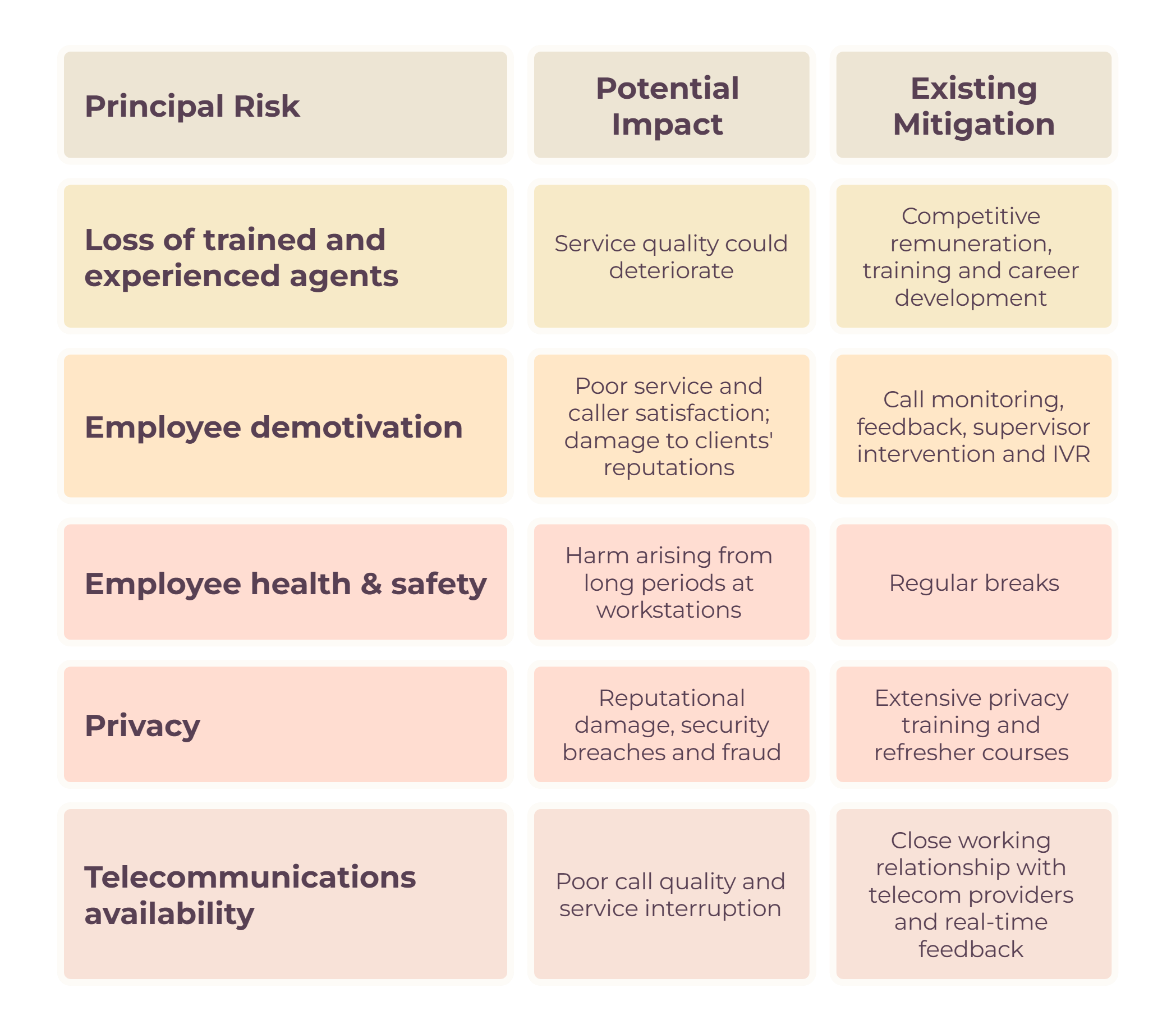
These are FACTS from the pre-seen.
Let’s look at what they mean strategically.
1. Retention of Trained and Experienced Agents
Vennlisk’s service quality is highly dependent on retaining capable agents.
This makes sense because the company invests significantly in training and staff development.
Its mitigation includes:
- competitive remuneration
- training
- staff development
and opportunities for employees to progress without needing to move to competitors.
Why does this matter?
If experienced agents leave, Vennlisk does not simply lose employees.
It could also lose:
- knowledge
- experience
- training investment
and
- service capacity.
Replacement employees then need to be recruited and trained.
ANALYSIS
This creates an important relationship:

That makes employee retention a strategic risk, not merely an HR issue.
2. Employee Demotivation
Even well-paid employees can become demotivated.
The pre-seen specifically warns that demotivated or careless agents could reduce caller satisfaction and potentially damage clients’ reputations.
Vennlisk therefore monitors call quality carefully.
Calls are recorded, supervisors review samples and employees receive feedback. Supervisors can also monitor calls in real time and intervene where necessary.
Some systems also use interactive voice response (IVR) for simple tasks, allowing agents to concentrate on more complex work.
The SCS issue
Monitoring creates an interesting balance.
Too little monitoring could allow poor performance to continue.
But excessive monitoring could potentially make employees feel pressured or distrusted.
ANALYSIS
Management therefore needs to balance:
Control + Productivity + Employee Motivation + Service Quality
This becomes even more important if Vennlisk expands its use of AI to monitor employee performance.
3. Health and Safety
Call-centre employees spend long periods sitting at workstations.
The pre-seen identifies this as a health and safety concern.
Vennlisk’s mitigation is to monitor employees to ensure they take regular breaks.
ANALYSIS
The Board should not view employee breaks simply as lost productive time.
Poor employee wellbeing could contribute to:
- absence
- lower motivation
- reduced productivity
- higher employee turnover
and potentially:
- poorer customer service.
This demonstrates another important Vennlisk tension:
Short-term productivity vs long-term employee welfare
4. Privacy Risk
Privacy is one of the most important risks in the Vennlisk case.
Agents can access client files while handling calls.
The pre-seen states that failure to protect privacy could cause:
- reputational damage
- security breaches
and
- fraud.
Vennlisk responds through extensive employee training on caller privacy, including relevant legal issues, together with regular updates and refresher courses.
Why is this strategically important?
Clients are effectively trusting Vennlisk with part of their relationship with their customers.
A serious privacy failure could therefore damage:
- caller trust
- client trust
- Vennlisk’s reputation
and potentially:
- future contract opportunities.
AI Could Make Privacy Risk More Complex
This is where students should connect different parts of the pre-seen.
Vennlisk is evaluating AI.
ANALYSIS / POSSIBLE ISSUE
If AI systems process caller or client information, management would need to consider:
- what data the AI accesses
- where information is stored
- who has access
- whether outputs are reliable
and
- whether existing controls remain sufficient.
This is additional analysis, not a risk specifically stated by CIMA as having already occurred.
But it is a very useful area for exam preparation.
5. Telecommunications Risk
Vennlisk’s operations depend on telecommunications links.
Breakdowns could result in:
- poor call quality
and
- service interruption.
Vennlisk works closely with telecommunications providers and gives real-time feedback when problems occur.
Why is this potentially serious?
For a call-centre business, telecommunications are not merely a support function.
They are fundamental to delivering the service.
If customers cannot reach Vennlisk’s agents:
Vennlisk cannot effectively deliver its core service.
A major outage could therefore affect:
- Service Level
- Call Abandonment Rate
- Customer Satisfaction
- client relationships
and potentially:
- revenue and reputation.
Are Vennlisk’s Existing Controls Enough?
A good SCS candidate should not simply say:
“Vennlisk has controls, therefore the risks are managed.”
Controls reduce risk.
They do not necessarily eliminate it.
For example:
Privacy training reduces the probability of employee mistakes, but it cannot guarantee that a privacy incident will never happen.
Regular breaks can help manage health risks, but management still needs to monitor employee welfare.
Working with telecom providers can help resolve problems, but it does not prevent every outage.
That is why the Board should consider residual risk — the risk remaining after controls have been applied.
This is an important P3 mindset.
Additional Risks Students Could Consider
The following are not presented in the pre-seen’s principal risk table as existing principal risks.
They are additional risks that could arise from Vennlisk’s strategy or from a future unseen development.
Cyber Risk
Greater reliance on digital systems and data could expose Vennlisk to cyber threats.
AI Implementation Risk
An AI project could exceed budget, fail to deliver expected benefits or create service problems.
Competitive Risk
Lower-cost overseas call centres could place pressure on pricing and margins.
Client Concentration Risk
If an unseen reveals significant dependence on a major client, losing that client could become financially important.
Important: The current pre-seen information should be checked before claiming that Vennlisk presently has a client-concentration problem.
Financial Risk
Vennlisk has significant borrowings and finance costs, which could become relevant when evaluating new investment or financing decisions.
These should be presented as analysis or possible issues, not as CIMA-stated principal risks.
Risk Is Connected to Vennlisk’s Strategy
One of the most important exam lessons is that risks do not exist independently.
Consider an AI investment.
It could create:
strategic opportunity
but also:
- implementation risk
- privacy risk
- cyber risk
- employee risk
- financial risk
and potentially:
- reputational risk.
Similarly, winning a huge new client could look positive.
But it could also create:
- capacity risk
- recruitment risk
- training risk
- service-quality risk
and
- working-capital requirements.
Therefore:
Every strategic opportunity should also be viewed through a risk lens.
How Should Vennlisk Assess Risks?
Technical P3 knowledge tells us that risks should be considered in terms of factors such as:
- likelihood
and
- impact.
The Board should also consider the effectiveness of controls and the residual risk that remains.
For Vennlisk, impact should not be considered purely financially.
A risk could affect:
- profit
- cash flow
- operations
- employees
- clients
- callers
- reputation
and
- shareholder value.
The significance of each impact will depend on the scenario.
What Should Vennlisk’s Board Do?
For major risks, the Board should ensure that management:
- identifies risks early
- assesses likelihood and impact
- assigns clear responsibility
- implements proportionate controls
- monitors whether controls work
- reviews residual risk
and
- updates the risk assessment when circumstances change.
The last point is particularly important.
Vennlisk’s risk profile could change significantly if it introduces AI, wins a major contract, makes an acquisition or changes its operating model.
CIMA SCS Exam Relevance
A future unseen could introduce a risk event such as:
- a privacy incident
- telecommunications failure
- loss of experienced employees
- falling employee morale
- AI implementation problems
- cyberattack
- major client complaint
- operational disruption
These are possible practice scenarios, not exam predictions.
If a risk scenario appears, don’t simply list risks.
For each significant issue, explain:

Example of Stronger SCS Analysis
Avoid:
“Vennlisk faces privacy risk and should provide training.”
The pre-seen already tells us Vennlisk provides extensive privacy training.
A stronger answer might say:
Vennlisk already provides extensive privacy training, so simply recommending additional training may not address the underlying cause of a new incident. Management should first establish whether the failure arose from employee behaviour, inadequate system controls or another weakness. The response should then target the cause, while the Board reviews whether the existing privacy-control framework remains appropriate.
That’s much more valuable.
It demonstrates that you have read the pre-seen and applied it.
Vennlisk Risk Summary
| Risk | Importance | Board Focus |
| Agent retention | High | Retention, development, succession |
| Demotivation | High | Motivation, monitoring, service quality |
| Health & safety | Important | Welfare, breaks, working conditions |
| Privacy | High | Training, controls, data governance |
| Telecommunications | High | Resilience and continuity |
| Cyber* | Potential | Security and technology controls |
| AI implementation* | Potential | Project and data governance |
| Competitive pressure* | Potential | Strategy, cost and differentiation |
*Additional analytical risks rather than principal risks listed in Vennlisk’s pre-seen risk table.
Final Takeaway
Vennlisk’s risk profile reflects the nature of its business.
Its success depends on:
People + Data + Technology + Telecommunications + Service Quality
The pre-seen identifies five principal risk areas: retention of trained agents, employee demotivation, health and safety, privacy and telecommunications availability.
But the SCS requires more than memorisation.
Students should be prepared to evaluate whether existing controls remain effective when circumstances change and advise the Board on what additional action is required.
FAQs
What are Vennlisk’s principal risks?
The pre-seen identifies risks relating to retention of trained and experienced agents, employee demotivation, employee health and safety, privacy and telecommunications availability.
Why is employee retention a risk for Vennlisk?
Vennlisk’s service quality depends heavily on trained and experienced agents. Losing them could affect service quality while also requiring recruitment and additional training.
Why is privacy important for Vennlisk?
Agents have access to client files. A failure to safeguard privacy could create reputational damage, security breaches and fraud.
How does Vennlisk manage call quality?
Calls are recorded and supervisors review samples, provide feedback and can monitor calls in real time and intervene where necessary.
Is cybersecurity a principal risk stated in Vennlisk’s risk table?
Cybersecurity is not separately listed among the five principal risks in that table. However, it is a relevant additional risk to consider when analysing Vennlisk’s dependence on technology, data and potential future AI developments.
Join our Free SCS Mini Course:
https://learn.keystoneacademia.com/course/cima-scs-nov-26-mini-course
Register for the free live session:
Keystone Academia – CIMA SCS Registration
Join our CIMA SCS WhatsApp community:
Join the Keystone Academia CIMA SCS WhatsApp Community
Next: Who Is Responsible for Governing These Risks?
Risk management ultimately depends on effective oversight.
Our next Keystone Academia article examines:
Vennlisk Board & Corporate Governance Analysis: Directors, Committees & Ethics
We’ll explore Vennlisk’s Board structure, responsibilities, committees and the governance implications students should understand for the CIMA SCS.