
Are you preparing for the CIMA OCS November 2026 exam and wondering where to start?
Should you revise E1, P1 or F1 first?
When should you start studying the CIMA OCS pre-seen?
How much time should you spend on technical revision?
When should you start attempting CIMA OCS mock exams?
And most importantly, how do you bring E1, P1 and F1 together and actually apply them in the Operational Case Study exam?
If these questions are running through your mind, this CIMA OCS November 2026 study plan will give you a clear roadmap.
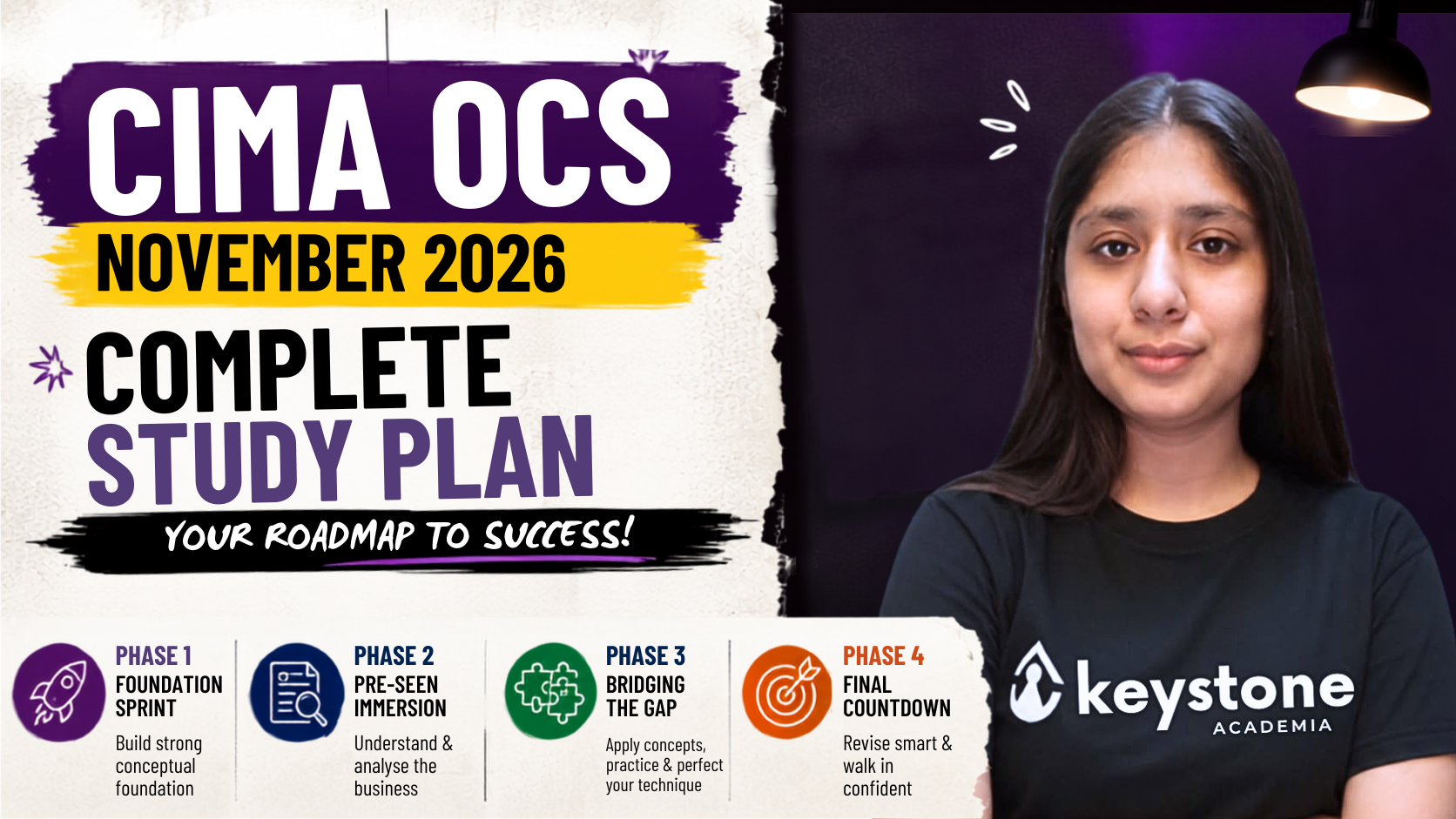
The aim is simple: instead of randomly revising topics and hoping you are exam ready, divide your preparation into four clear phases.
- Foundation Sprint
- Pre-seen Immersion
- Bridging the Gap and Exam Practice
- Final Countdown
This approach gives you approximately two months to move from technical revision to pre-seen analysis, application, answer writing and timed mock exam practice.
Watch the Full CIMA OCS November 2026 Study Plan
I explain the complete strategy step by step in this video:
If you are planning to sit the CIMA Operational Case Study November 2026 exam, watch the video first and then use this article as your detailed study roadmap.
What Is the CIMA Operational Case Study Exam?
The CIMA Operational Case Study is not simply another technical accounting examination.
It requires you to bring together your knowledge from the three Operational Level subjects:
- E1
- P1
- F1
You then need to apply that knowledge to a fictional organisation and the business situations presented during the examination.
This distinction is extremely important.
Knowing the definition of zero based budgeting is useful.
Knowing how zero based budgeting could be implemented in the organisation in your case study is much more important.
Similarly, memorising an IFRS rule is only the starting point. You need to recognise when that standard becomes relevant to an unseen scenario and explain its implications for the organisation.
That is why a strong CIMA OCS preparation strategy must combine:
Technical knowledge + Pre-seen knowledge + Application + Exam technique + Timed practice
How Long Do You Need to Prepare for CIMA OCS November 2026?
Starting at the beginning of September gives you roughly two months to prepare for the November examination.
That can be sufficient if those two months are properly structured.
The mistake is to spend the entire period simply reading E1, P1 and F1 textbooks.
Your preparation needs to evolve.
At the beginning, your priority is technical knowledge.
Once the pre-seen arrives, your attention moves towards understanding the organisation.
After that, you connect your technical knowledge with the pre-seen.
Finally, you move heavily towards exam technique and timed mock examinations.
This gives us our four phase CIMA OCS study plan.
Phase 1: CIMA OCS Foundation Sprint
The first phase is about rebuilding your technical foundation.
For the first two weeks of September, concentrate heavily on F1 and P1 technical revision.
Why?
Because the Operational Case Study can be technically demanding.
You may need to discuss or apply concepts relating to:
- IFRS
- Financial reporting
- Working capital
- Cash management
- Costing
- Budgeting
- Forecasting
- Standard costing
- Variances
- Performance measurement
- Short term decision making
- Relevant costing
- Risk
- Decision making under uncertainty
- Tax
- Corporate governance
If the technical foundation is weak, applying those concepts to the pre-seen becomes much harder.
Week 1: F1 Revision for CIMA OCS November 2026
Use the first week primarily for F1.
A simple approach is to revise approximately two chapters or major topic areas each day.
Do not try to read hundreds of pages without stopping.
The purpose of this week is to reactivate the technical knowledge you already studied and identify areas requiring further revision.
Key F1 Topics for CIMA OCS
Your revision should include areas such as:
Financial Reporting
Make sure you understand the underlying financial reporting principles and can explain them clearly.
Do not only memorise standard numbers.
You should understand:
- What the relevant standard covers
- Recognition requirements
- Measurement requirements
- Accounting treatment
- Potential impact on financial statements
- How the rule could apply to a business scenario
Revenue Recognition
Revenue recognition can become particularly important where the unseen introduces a new product, contract, service or commercial arrangement.
When revising, ask:
- When should revenue be recognised?
- How much should be recognised?
- Is there more than one performance obligation?
- What could change the timing of revenue recognition?
Non-current Assets
Revise important principles relating to areas such as:
- Property, plant and equipment
- Intangible assets
- Impairment
Do not stop at definitions.
Think about possible OCS scenarios such as purchasing equipment, developing technology, impairment indicators, expansion projects and disposal decisions.
Working Capital Management
Working capital is a major practical finance area.
Revise:
- Inventory management
- Receivables management
- Payables management
- Cash management
- Working capital cycle
- Short term financing
You should be comfortable both calculating and interpreting working capital information.
Taxation
Refresh the relevant tax principles from F1 and think about how tax affects business decisions.
Corporate Governance
Understand governance responsibilities and how governance issues can influence decision making, accountability and control.
Create Your Own CIMA OCS Revision Notes
While revising F1, keep a separate notebook, Word document or Excel sheet.
Do not copy the entire textbook.
Create concise revision notes containing:
- Key definitions
- IFRS rules
- Formulas
- Advantages and disadvantages
- Steps in a process
- Common calculations
- Common application points
- Areas you regularly forget
These notes become extremely valuable during the final stages of your CIMA OCS November 2026 revision.
Instead of reopening entire textbooks before the exam, you can return to your personalised technical summary.
Week 2: P1 Revision for CIMA OCS November 2026
Once your F1 revision is complete, move into P1.
Again, a sustainable approach is approximately two chapters or major topic areas per day.
Costing
Start with the fundamentals of costing.
Make sure you understand concepts such as:
- Absorption costing
- Marginal costing
- Overhead allocation
- Cost behaviour
- Contribution
The goal is not simply to calculate numbers.
Ask yourself:
Why would management use this costing method?
What decision could this information support?
That mindset is much closer to the case study examination.
Activity Based Costing
ABC is an important area to understand.
Revise:
- Activities
- Cost pools
- Cost drivers
- Allocation of overheads
- Advantages of ABC
- Limitations of ABC
- Situations where ABC could provide better information
Then think about whether the pre-seen organisation could benefit from ABC.
That is the transition from objective test thinking to case study thinking.
Budgeting and Forecasting
Revise different approaches including:
- Incremental budgeting
- Zero based budgeting
- Rolling budgets
- Forecasting techniques
- Planning and control
For each technique, learn more than the definition.
For example, for zero based budgeting, you should understand:
- What zero based budgeting means
- How it works
- The steps required to implement it
- Its advantages
- Its disadvantages
- Whether it would suit the pre-seen organisation
- How managers and employees could react to it
That is how you prepare a technical concept for a case study examination.
Standard Costing and Variances
Revise:
- Standard costing
- Basic variance calculations
- Advanced variances
- Interpretation of variances
- Possible causes of variances
- Management responses
Remember that calculating a variance is only part of the skill.
A case study could require you to explain why the variance occurred and what management should do about it.
Performance Measurement
Revise both financial and non-financial performance measures.
Think about:
- KPIs
- Operational measures
- Financial measures
- Customer measures
- Employee measures
- Efficiency measures
- Quality measures
Later, you will map these KPIs directly to the departments and operations of the November 2026 pre-seen company.
Operational Risk
Revise areas such as:
- Risk identification
- Risk assessment
- Risk registers
- Risk heat maps
- Risk responses
- Controls
Do not study risk in isolation.
Ask yourself:
What are the operational risks facing the pre-seen organisation?
Decision Making Under Uncertainty
Make sure you can apply the relevant decision making techniques and understand their limitations.
You should also be comfortable distinguishing between relevant and non-relevant information when making short term decisions.
Phase 2: CIMA OCS November 2026 Pre-seen Analysis
Once the CIMA OCS November 2026 pre-seen is released, your study approach should change.
For the first two days, resist the temptation to immediately predict exam questions.
First, understand the business.
Day 1 and Day 2: Read the Pre-seen Repeatedly
Read the pre-seen several times.
Your objective is immersion.
You want to understand:
- What the company does
- How it makes money
- Its products and services
- Its customers
- Its industry
- Its competitors
- Its ownership
- Its management structure
- Its strategy
- Its operations
- Its financial position
- Its risks
- Its future plans
The organisation should eventually become familiar enough that you can discuss it without constantly returning to the document.
Do not immediately try to memorise every number.
First understand the story.
Day 3: Complete Your CIMA OCS Pre-seen Analysis
After reading the document several times, begin structured analysis.
This should include:
SWOT Analysis
Identify the organisations:
- Strengths
- Weaknesses
- Opportunities
- Threats
Avoid generic SWOT points.
Every point should come from the pre-seen or be clearly connected to the industry and organisation.
PESTEL Analysis
Consider the external environment through:
- Political factors
- Economic factors
- Social factors
- Technological factors
- Environmental factors
- Legal factors
Again, the purpose is not to produce a textbook definition of PESTEL.
The purpose is to identify which external factors could actually affect the pre-seen organisation.
Financial Statement Analysis
Calculate and interpret the important ratios available from the pre-seen.
Consider:
Profitability
- Gross profit margin
- Operating profit margin
- Net profit margin
- Return measures where relevant
Liquidity
- Current ratio
- Quick ratio
- Working capital position
Working Capital
- Inventory days
- Receivable days
- Payable days
- Working capital cycle
Financing and Solvency
- Gearing
- Interest cover
- Debt position
Cash Flow
Do not ignore cash flow.
A profitable organisation can still experience liquidity problems.
Look at:
- Operating cash generation
- Capital expenditure
- Financing cash flows
- Dividends
- Changes in cash balances
The purpose of CIMA OCS financial analysis is not merely calculating ratios.
You must interpret what those ratios tell you about the organisation.
Phase 3: Bridge the Gap Between E1, P1, F1 and the Pre-seen
You now have two sets of knowledge.
First, you have your E1, P1 and F1 technical knowledge.
Second, you understand the pre-seen organisation.
Now you need to connect them.
This is one of the most important stages of CIMA Operational Case Study preparation.
Map F1 to the CIMA OCS Pre-seen
Take your F1 revision notes and ask:
Which F1 concepts could realistically apply to this organisation?
For example:
- Could revenue recognition become relevant?
- Does the company have significant PPE?
- Could impairment become relevant?
- Does it have inventory issues?
- How does it manage cash?
- Does it have working capital concerns?
- Could expansion create financing requirements?
- Are there governance issues?
- Could a new project create tax implications?
Write those connections down.
Map P1 to the CIMA OCS Pre-seen
Now repeat the process with P1.
Ask:
- What costing system does the company appear to use?
- Could ABC improve its costing information?
- What are its major cost drivers?
- How does it budget?
- Could zero based budgeting be appropriate?
- Which variances might management monitor?
- What KPIs should management use?
- What operational risks exist?
- What short term decisions might arise?
- Could make or buy decisions arise?
- Which costs would be relevant to those decisions?
This is where your technical revision starts becoming genuine case study preparation.
Bring E1 Into the CIMA OCS
E1 helps you connect finance with the wider organisation and the changing business environment.
Think about areas such as:
- Digital finance
- Technology
- Data
- Information systems
- Finance function transformation
- Organisational strategy
- Business processes
- Stakeholders
- Digital tools
Ask practical questions.
Could the organisation use better technology?
Could automation improve a process?
Could management use data analytics more effectively?
Where would the data come from?
Would investment be required?
What would the financial impact be?
What risks would arise?
What controls would be necessary?
This demonstrates why you should not treat E1, P1 and F1 as completely separate subjects when preparing for OCS.
Use the CIMA Operational Case Study Exam Blueprint
One of the most important official resources for your preparation is the CIMA Operational Level Examination Blueprint.
Do not prepare only chapter by chapter.
The blueprint helps you understand how your knowledge is organised around the activities expected from an Operational Level finance professional.
Once you are comfortable with the underlying E1, P1 and F1 knowledge, revise again from the perspective of the core activities.
Core Activity A: Costing Information
Revise costing information that supports the different needs of the business.
Important areas may include:
- Absorption costing
- Marginal costing
- Activity based costing
- Cost drivers
- Cost behaviour
- Relevant costing
- Other relevant costing approaches from your syllabus
Then connect those concepts to the pre-seen.
Ask:
- Which costing approach is currently used?
- Is the costing information accurate enough?
- Could another costing method improve decision making?
- What are the major cost drivers?
- Could management improve cost control?
Core Activity B: Budgeting, Planning and Control
Revise:
- Budgeting
- Forecasting
- Zero based budgeting
- Rolling budgets
- Planning
- Control
- Feedback control
- Feedforward control
Then consider what budgeting method the pre-seen company currently uses and whether another approach might be appropriate.
Core Activity C: Organisational Performance
You should be comfortable analysing both financial and non-financial information.
A useful exercise is to look at the organisational structure in the pre-seen and develop KPIs for each important department.
Possible categories include:
- Revenue
- Profitability
- Cost control
- Productivity
- Customer satisfaction
- Employee turnover
- Quality
- Capacity utilisation
- Efficiency
- Digital performance
- Sustainability where relevant
The key is to recommend KPIs that actually help management make decisions.
Core Activity D: Financial Reporting, Governance, Ethics and Tax
This is where strong F1 technical knowledge becomes particularly important.
Return to the financial reporting topics that you previously mapped against the pre-seen.
For every relevant accounting standard, ask:
- What does the standard require?
- Why could it become relevant?
- What accounting treatment would be required?
- What would happen to profit?
- What would happen to assets or liabilities?
- What additional information would management need?
Also revise the relevant principles of:
- Corporate governance
- Ethics
- Taxation
Core Activity E: Short Term Decision Making
This area brings together knowledge from different parts of the Operational Level.
Revise:
- Relevant costing
- Non-relevant costs
- Make or buy decisions
- Short term financing
- Short term investment
- Risk and uncertainty
- Decision making techniques
The key is application.
If management is considering two alternatives, you should be able to identify:
- Relevant cash flows
- Avoidable costs
- Opportunity costs
- Sunk costs
- Qualitative considerations
- Risks
- Operational consequences
Core Activity F: Working Capital
Working capital can be both technical and highly practical.
Be comfortable with:
- Inventory
- Receivables
- Payables
- Cash
- Working capital cycle
- Short term finance
Do not simply memorise formulas.
Understand cause and effect.
For example:
What happens if inventory days increase?
More cash may become tied up in inventory.
What happens if receivable days increase?
Cash collection slows and the working capital requirement may increase.
What happens if payable days increase?
The business retains cash for longer, although supplier relationships and payment terms must also be considered.
This is the level of interpretation required for effective case study preparation.
CIMA OCS Answer Writing Technique
Technical knowledge alone will not produce a strong OCS answer.
You must communicate that knowledge in the context of the scenario.
A practical structure is:
Introduction
Briefly establish the relevant technical concept.
If the requirement concerns an accounting standard, explain the relevant principle.
If it concerns a costing technique, briefly establish what that costing technique means.
Keep this focused.
Do not spend half your answer reproducing textbook knowledge.
Body
This is where the marks are likely to be won.
Apply your knowledge directly to:
- Pre-seen information
- Unseen information
- Financial data
- Operational data
- Management concerns
- Risks
- Strategic or operational consequences
A useful mental model is:
Point + Application + Business Impact
For example:
What is the issue?
How does it specifically affect this company?
Why does it matter?
What should management consider doing?
Conclusion or Recommendation
Where the requirement asks you to recommend, evaluate, advise or interpret, provide a clear conclusion.
Avoid finishing with vague language.
If the evidence supports option A, explain why option A is preferable.
If neither option is clearly superior, explain what additional information management should obtain before making the decision.
Use CIMA Pilot Papers and Real Exam Style Resources
Do not learn answer writing only by reading theory.
Study official exam style materials and examine how answers are constructed.
Look for patterns:
- How technical knowledge is introduced
- How much theory is included
- How scenario information is used
- How paragraphs are structured
- How calculations are interpreted
- How recommendations are justified
Your objective is not to memorise model answers.
Your objective is to understand how a professional CIMA case study response is constructed.
Final Two Weeks: CIMA OCS Mock Exam Strategy
The final two weeks should become heavily practice focused.
At this point you should already have:
- Revised F1
- Revised P1
- Revised E1
- Read the pre-seen repeatedly
- Analysed the pre-seen
- Completed financial analysis
- Mapped E1, P1 and F1 to the pre-seen
- Revised the core activities
- Studied answer technique
Now you need to perform under examination conditions.
Complete at Least Three CIMA OCS Mock Exams
A good minimum target is three full mock examinations.
But do not complete three mocks on consecutive days without reflection.
Use a cycle such as:
Mock Exam → Review → Technical Revision → Application Practice → Next Mock
After every mock, identify:
- Technical knowledge gaps
- Weak application
- Poor time management
- Weak conclusions
- Insufficient use of scenario information
- Poor structure
- Missed calculations
- Weak commercial reasoning
Then correct those weaknesses before attempting the next mock.
Doing five mocks without learning from them can be less useful than doing three mocks with detailed review.
How to Review a CIMA OCS Mock Exam
After completing a mock, ask yourself:
Technical Knowledge
Did I know the relevant E1, P1 or F1 concept?
Application
Did I connect my answer to the company and unseen information?
Depth
Did I explain why the issue matters?
Finance Officer Mindset
Did I write as somebody working inside the organisation, or did I write like a student reproducing textbook notes?
Recommendation
Where required, did I make a clear and commercially sensible recommendation?
Time Management
Did I allocate enough time across the examination?
These questions turn mock exams into learning tools.
Phase 4: Final Countdown Before CIMA OCS November 2026
The final days are not the time to restart the entire syllabus.
Your preparation should become narrower.
Focus on:
- Weak areas identified through mocks
- Important formulas
- Relevant IFRS principles
- Pre-seen facts
- Key financial ratios
- Important risks
- Core activity mapping
- Common decision making techniques
- Your own revision notes
This is exactly why creating concise notes throughout your preparation is so useful.
The Night Before the CIMA OCS Exam
Do not attempt an enormous final revision session.
At this stage, your objective is to arrive at the examination capable of thinking clearly.
Review only the important points you need to remember.
Then get proper rest.
You need concentration, judgement and the ability to apply information during a three hour case study examination.
CIMA OCS November 2026 Exam Day Strategy
On exam day:
- Have a light meal
- Avoid trying to relearn entire chapters
- Review only essential notes if necessary
- Stay focused on application
- Read requirements carefully
- Use the unseen information
- Write professionally
- Manage your time
- Make clear recommendations when required
Remember that you are responding as a finance professional within the case organisation.
Your answers should therefore sound like practical advice to management rather than a textbook chapter.
CIMA OCS November 2026 Study Plan Summary
Your complete preparation roadmap can therefore look like this:
Phase 1 – Foundation Sprint
Revise F1 and P1 thoroughly and build concise technical notes.
Phase 2 – Pre-seen Immersion
Read the CIMA OCS November 2026 pre-seen repeatedly and then complete SWOT, PESTEL and financial analysis.
Phase 3 – Bridge and Apply
Map F1 and P1 against the pre-seen, revise E1 through the context of the organisation, work through the Operational Level core activities, study answer technique and complete timed mocks.
Phase 4 – Final Countdown
Use mock feedback to revise your weaknesses, review your concise notes and avoid overwhelming yourself immediately before the examination.
Useful Links for CIMA OCS November 2026 Students
Full Video
CIMA OCS November 2026 Complete Study Plan
Official CIMA Study Support
Access official study resources, exam preparation support and the CGMA Study Hub:
CIMA Operational Level Resources
Operational Level information, exam resources and related guidance:
CIMA Examination Blueprints
Use the official examination blueprint relevant to the 2026 to 2027 examination period:
CIMA Exam Timetable
Check official exam windows, scheduling dates, pre-seen release dates and result dates:
CGMA Operational Level Confidence Guide
Use the Operational Level Confidence Guide to understand the stages of becoming exam ready:
CGMA Proficiency Guide
Use the Operational Level Proficiency Guide for additional case study exam preparation and exam technique support:
CIMA Self Tailored Learning Pathway
Information about the Operational Level, E1, P1, F1 and Operational Case Study assessment:
CGMA Professional Qualification 2026 Upgrade
Review the technical changes relevant to the upgraded qualification and case study examinations from May 2026 onwards:
Frequently Asked Questions About CIMA OCS November 2026
How should I prepare for CIMA OCS November 2026?
Start by refreshing your F1 and P1 technical knowledge. Once the pre-seen is released, analyse the organisation and then map E1, P1 and F1 concepts directly to the case. Finish your preparation with answer writing practice and timed mock exams.
Is two months enough to prepare for CIMA OCS?
Two months can provide a strong preparation window if your study is structured and you already have the underlying Operational Level knowledge. Your plan should progressively move from technical revision towards application and mock exam practice.
What should I study first for CIMA OCS?
A practical approach is to begin with the technical areas of F1 and P1 before moving heavily into the pre-seen. Once you understand the case organisation, bring E1 into the preparation and connect all three Operational Level subjects to the case.
How do I analyse the CIMA OCS pre-seen?
Read the pre-seen several times before trying to predict questions. Then analyse the business model, industry, stakeholders, strategy, financial performance, SWOT, PESTEL, risks, opportunities and potential technical areas.
How many CIMA OCS mock exams should I complete?
Aim for at least three properly timed mock examinations if possible. More can be useful, but reviewing each mock and closing your knowledge and application gaps is more important than simply completing a large number.
How should I structure a CIMA OCS answer?
Start with only the technical explanation necessary to address the requirement. The majority of the response should apply that knowledge to the pre-seen and unseen scenario. Where appropriate, finish with a clear conclusion or recommendation.
Should I memorise the CIMA OCS pre-seen?
Do not try to memorise every sentence. Aim to become extremely familiar with the organisation, its business model, industry, management, operations, financial position, strategy, risks and opportunities.
Is F1 important for CIMA OCS?
Yes. F1 knowledge can become relevant when the scenario involves financial reporting, taxation, governance, cash management, working capital and other financial matters.
Is P1 important for CIMA OCS?
Yes. P1 provides important technical knowledge for costing, budgeting, performance measurement, variances, short term decision making, risk and related operational decisions.
Is E1 important for CIMA OCS?
Yes. E1 helps you consider the organisation, finance function, technology, data, processes and broader business environment. It should be applied together with P1 and F1 rather than treated as an isolated subject.
What is the biggest mistake students make in CIMA OCS?
One major mistake is knowing technical theory but failing to apply it specifically to the case.
Your answer should continually explain what the information means for the organisation in the scenario.
Final Thoughts
Passing the CIMA Operational Case Study November 2026 exam is not about reading the pre-seen hundreds of times or memorising model answers.
You need to build layers of preparation.
First, strengthen your technical knowledge.
Second, understand the pre-seen business.
Third, connect E1, P1 and F1 to that business.
Fourth, understand how those concepts can appear through the Operational Level core activities.
Finally, practise communicating your knowledge under timed examination conditions.
If you follow this process consistently, you can walk into the November 2026 OCS exam with a structured understanding of what you know, how it applies and how you need to communicate it.
Watch the complete CIMA OCS November 2026 study plan here: