
We Reviewed a Kwirtmak Mock. Here’s What You Should Learn From It Before the Exam.
If you are sitting the CIMA SCS August 2026 exam, you are very close now.
At this stage, reading another chapter may not change much.
But seeing where a real mock answer worked — and where it could have gone further — can.
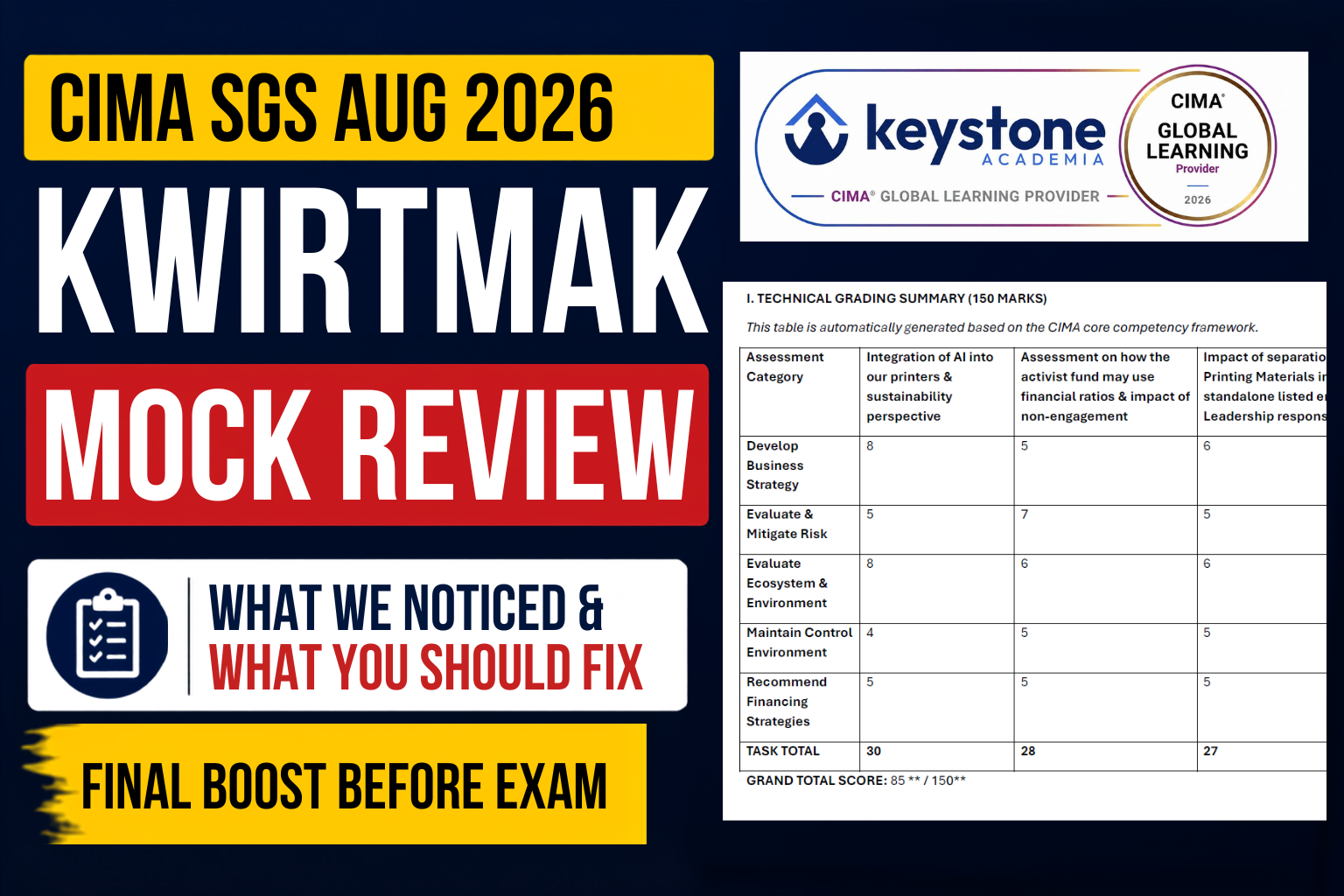
We recently reviewed a full Kwirtmak mock covering AI, sustainability, activist investors, financial performance, business separation and leadership.
And one thing kept coming up.
The student often found the right issue. But some good points stopped too early.
That matters.
In SCS, knowing that something is a risk is only the start.
You need to explain:
Why is it a risk for Kwirtmak?
What could happen because of it?
What does it mean financially?
Who will be affected?
And what should management actually do?
The mock feedback repeatedly came back to the same areas: stronger quantification, more scenario-specific evidence, deeper recommendations, clearer controls and more detail on implementation.
With the exam only days away, these are worth fixing.
1. Good Application Is Not Enough. Push the Point Further.
The AI requirement was one of the stronger parts of the mock.
The answer picked up an important problem in Kwirtmak.
Printer sales are volatile.
Kwirtmak’s revenue fell from E$2,856.6 million in 2025 to E$2,320.0 million in 2026, a fall of around 18.8%. Profit for the year also dropped from E$1,142.4 million to E$810.6 million.
So the mock made a sensible argument.
If Kwirtmak builds a connected digital offering around its installed printers, it may be able to generate more recurring revenue instead of depending so heavily on customers buying new hardware.
That is a good point.
But don’t stop there.
Ask yourself:
So what?
If recurring revenue increases, Kwirtmak could get more predictable revenue and cash flow.
So what?
That could make the business less exposed to swings in hardware demand.
So what?
It could support investment planning and potentially give investors more confidence in future earnings.
Now we are getting somewhere.
And then comes the next question:
How will the Board know whether the strategy is working?
You could suggest measures such as:
- percentage of printers connected to the platform;
- subscription revenue;
- customer renewal rates;
- recurring revenue per customer;
- customer retention;
- reduction in printer downtime;
- revenue from additional digital services.
This was one of the clearest lessons from the mock.
Don’t just explain the benefit. Explain how Kwirtmak will know whether the benefit has actually happened.
2. AI Is Not Just an E3 Topic
It is easy to see AI and immediately think:
innovation, competitive advantage, digital strategy.
All relevant.
But that is only one part of the answer.
The mock did something useful here. It recognised that if Kwirtmak connects customers’ printers to a digital platform, cybersecurity becomes strategically important.
Customers may be sharing operational data. Some customers may also work in industries where security and regulatory requirements are particularly important.
A security failure could therefore do more than create an IT problem.
It could make customers reluctant to use the platform in the first place.
Think about that chain:
AI opportunity → connected printers → more data → cyber exposure → customer trust → adoption → financial return.
That is what E3, P3 and F3 integration should feel like.
Not three textbook paragraphs.
One connected argument.
And the recommendation should also be practical.
Instead of:
Kwirtmak should manage cybersecurity risk.
Try:
Before a wider rollout, Kwirtmak should test the platform’s security, establish clear access and data controls, and confirm how customer data will be protected. The Board should also monitor cyber incidents and customer adoption because weak security could directly affect whether the investment delivers the expected recurring revenue.
Much better.
3. Ratios Are Evidence. They Are Not the Answer.
This is important for the Kwirtmak case.
The mock used several financial measures when discussing the activist investor.
That included shareholder returns, beta, revenue and profit trends, gearing and interest cover.
Good.
But a ratio only becomes useful when you explain what somebody might do with that information.
Take Kwirtmak’s beta of 2.3.
You could write:
Kwirtmak has a beta of 2.3, so it has high systematic risk.
Correct.
But there is more to say.
If investors see Kwirtmak as higher risk, they are likely to require a higher return.
That can increase the cost of equity.
And a higher required return can put pressure on valuation and make it harder for future investments to create shareholder value.
Now the number is doing some work.
The same applies to Kwirtmak’s declining revenue.
The important point is not simply that revenue fell.
Look at Breskko.
Kwirtmak’s closest competitor increased revenue from E$2,744.6 million to E$3,016.0 million, while Kwirtmak’s revenue fell to E$2,320.0 million.
Imagine you are an activist shareholder.
That comparison gives you a much stronger argument:
“If the market is difficult, why is the closest competitor growing while Kwirtmak is shrinking?”
That puts pressure on management.
It raises questions about strategy, competitiveness, execution and capital allocation.
This is the level you want in the exam.
Don’t calculate and move on. Interpret. Compare. Challenge.
4. Be Careful With “Kwirtmak Can Borrow More”
The mock also considered gearing and interest cover.
The argument was that Kwirtmak could potentially have further borrowing capacity.
Reasonable.
But this is where you need balance.
Kwirtmak had E$1,350 million of long-term borrowings at 31 March 2026, and finance costs were E$108 million.
So even if current interest cover appears comfortable, ask another question:
What happens if profits fall again?
And another:
What if Kwirtmak needs significant funding for AI, digital infrastructure, R&D or another strategic project?
And another:
Would taking on more debt now reduce financial flexibility later?
This is the difference between knowing F3 and using F3.
Do not make financing recommendations from one ratio.
Look at:
risk + cash flow + future strategy + existing debt + shareholder expectations + financial flexibility.
5. The Activist Investor Requirement Had One Very Good Insight
One point in the mock is worth remembering.
The activist investor is looking largely at information available to the market.
But Kwirtmak’s Board may know much more about future plans, investment requirements and the reasons behind current decisions.
That creates an information gap.
And it leads to a practical problem.
If Kwirtmak says nothing while performance is falling, investors may create their own explanation.
The mock correctly identified risks from refusing to engage, including pressure on the share price, wider shareholder concern, analyst scrutiny, employee uncertainty and management distraction.
But again, don’t stop at:
The Board should engage with shareholders.
What does “engage” actually mean?
Kwirtmak could:
- meet the activist fund and understand its concerns;
- speak with major institutional investors;
- explain why performance has deteriorated;
- set out the recovery strategy;
- explain how capital is being allocated;
- provide measurable milestones;
- report progress against those milestones.
That is a recommendation.
“Improve communication” is not.
6. Green Bonds: Don’t Write an ESG Paragraph
The sustainability and funding section also had some good thinking.
The mock recognised that if Kwirtmak uses green bonds to finance a project, it needs to be clear about what makes the investment environmentally sustainable.
That means measurable outcomes.
Not:
The project is environmentally friendly.
But things such as:
- lower material waste;
- lower energy consumption;
- reduced emissions;
- longer equipment life;
- improved resource efficiency.
Then ask:
Who measures this?
How is it verified?
What gets reported to investors?
What happens if the environmental benefits are below expectations?
The mock also picked up the risk of greenwashing.
That matters because this is not only a sustainability issue.
If investors believe Kwirtmak has exaggerated the environmental benefits of a financed project, the damage could affect reputation, investor trust and future access to finance.
See how the pillars connect?
Sustainability affects strategy.
Claims create risk and control requirements.
And those claims can affect financing.
That is SCS.
7. The Printing Materials Separation Is More Complicated Than “Unlocking Value”
The mock also looked at separating Kwirtmak’s Printing Materials business into a standalone listed company.
There are obvious arguments in favour.
A separate company could have:
- clearer strategic focus;
- its own management;
- independent capital allocation;
- a clearer market valuation;
- investors who specifically want exposure to that business.
But here is the problem.
Kwirtmak does not simply sell printers.
Printing materials form part of the wider customer relationship.
And the materials business can provide recurring revenue after a printer has been sold.
So what happens if Kwirtmak separates it?
The hardware business could lose part of that recurring income.
There may also be duplicated functions such as finance, HR and IT.
And the separation could weaken Kwirtmak’s ability to offer customers an integrated solution. These issues were all picked up in the mock analysis.
This creates a much better discussion.
The question is not:
“Is a demerger good?”
The question is:
“Could the financial benefits of separation be greater than the strategic and operating benefits Kwirtmak currently gets from keeping the businesses together?”
That is a Board-level question.
8. Don’t Treat Leadership as a Soft Topic
The leadership section was another useful part of the mock.
Think about what happens if Kwirtmak moves further towards AI and software.
Some employees have built their careers around hardware and engineering.
They may hear “AI transformation” and think:
What happens to my job?
That reaction matters.
Because resistance can slow implementation.
Good employees may leave.
Training costs can rise.
Projects can be delayed.
And the expected financial benefits may not arrive.
The mock suggested Board oversight, a clear change owner, communication, training, phased implementation and career paths for employees.
These are sensible recommendations.
But make them specific.
Don’t say:
Kwirtmak should train employees.
Ask:
Train them in what?
First identify the skills gap.
Then decide which capabilities should be developed internally and which may need external recruitment.
Then measure whether the training has worked.
For example:
- training completion;
- competency assessments;
- employee engagement;
- staff turnover;
- adoption of new systems;
- productivity;
- project milestones.
Leadership is not separate from financial performance.
If people do not implement the strategy, the investment does not deliver the return.
So Where Were Marks Being Left Behind?
After reviewing the mock, the main issue was not a lack of knowledge.
There was good commercial thinking in several areas.
The bigger opportunity was development.
A point would start well, but could have gone one stage further.
For example:
Good:
AI could create recurring revenue.
Better:
Recurring revenue could reduce Kwirtmak’s dependence on volatile printer sales.
Stronger:
Recurring revenue could reduce dependence on volatile printer sales and improve cash-flow predictability, but this depends on customer adoption.
Stronger again:
Kwirtmak should therefore pilot the service and monitor adoption, subscription revenue, retention, system reliability and cyber incidents before committing to a wider rollout.
See the difference?
You do not necessarily need more knowledge.
You need to do more with each relevant point.
A Simple Way to Check Your Answer
When you finish a paragraph in the exam, ask:
Have I used Kwirtmak?
Have I explained why this matters?
Have I explained what could go wrong?
Is there a financial impact?
Which stakeholder cares?
Have I actually recommended something useful?
And one more:
Could the Board act on what I have written?
If the answer to that last question is no, your recommendation may still be too generic.
What I Would Focus on in the Final Two Days
Do not try to predict the exact CIMA SCS August 2026 unseen.
Instead, make sure you can think around the main tensions already sitting inside Kwirtmak.
For example:
- declining performance while Breskko grows;
- hardware sales versus recurring revenues;
- AI opportunity versus cyber and data risk;
- innovation versus investment cost;
- R&D needs versus pressure on current performance;
- dividends versus reinvestment;
- shareholder pressure versus long-term strategy;
- sustainability claims versus measurable evidence;
- green funding versus financial flexibility;
- integrated printers and materials versus business separation;
- digital transformation versus employee readiness.
Any unseen could change the situation.
But if you understand these tensions, you have somewhere to start.
One Final Example
Imagine the unseen says Kwirtmak wants to invest heavily in Smart Print.
You could write:
Smart Print will generate recurring revenue.
Too short.
Or:
Smart Print could generate recurring revenue from Kwirtmak’s installed printer base, reducing its dependence on volatile hardware sales.
Better.
But I would want you to keep going:
Smart Print could generate recurring revenue from Kwirtmak’s installed printer base, reducing its dependence on volatile hardware sales and potentially improving cash-flow predictability. It could also strengthen customer relationships through services such as predictive maintenance. However, the benefits depend on customers being willing to connect their printers and share data. Cybersecurity, implementation cost and customer adoption therefore need to be assessed before a full rollout. Kwirtmak could start with a pilot and monitor subscription uptake, recurring revenue, customer retention, downtime improvements and cyber incidents before committing further investment.
That paragraph is doing several things at once.
Strategy.
Risk.
Finance.
Customers.
Controls.
Implementation.
And it still sounds like one connected answer.
That is what you want.
Final Thought Before the CIMA SCS August 2026 Exam
If your exam is in two days, don’t panic because you cannot remember every model in E3, P3 and F3.
That is not the target now.
Know Kwirtmak.
Know the numbers.
Understand why its performance matters.
Understand where the strategic tensions are.
And when the unseen arrives, keep asking:
Why does this matter to Kwirtmak?
What happens next?
What could go wrong?
What does it mean financially?
What should management do about it?
A lot of students can identify the issue.
Your job is to take it further.
Frequently Asked Questions
What should I revise for CIMA SCS August 2026 in the final two days?
Focus on Kwirtmak rather than trying to relearn the whole syllabus. Review the financial position, key risks, strategy, competitors, stakeholders and the main links between E3, P3 and F3. Then practise applying them to short unseen scenarios.
Is Kwirtmak financial analysis important for the CIMA SCS August 2026 exam?
Yes. But don’t memorise ratios without understanding them. Know what the changes in revenue, profitability, debt, investment and competitor performance could mean for management decisions.
How do I integrate E3, P3 and F3 in a CIMA SCS answer?
Don’t write three separate textbook sections. Follow the issue. A digital investment, for example, can affect strategy and competitive advantage, create implementation and cyber risks, and require funding while affecting cash flow and shareholder value.
How can I improve my CIMA SCS recommendations?
Be specific. Explain what Kwirtmak should do, how it should do it and what should be monitored. Where relevant, identify controls, KPIs, responsibilities and implementation stages.
What is the biggest lesson from this Kwirtmak mock review?
Good points need development. Identifying the right issue is not enough. Connect it to Kwirtmak, explain the consequence, consider risk and finance, and finish with a practical management response.