
Once you decide that CIMA could be right for you, the next question is usually much more practical:
How does the CIMA qualification actually work?
This is where things can become confusing. You will hear about Operational, Management and Strategic levels, Objective Tests, Case Study exams, FLP, exemptions and fast-track pathways. The route is also not the same for everyone.
A graduate starting a finance career may have a very different CIMA journey from a Finance Manager with 15 years of experience.
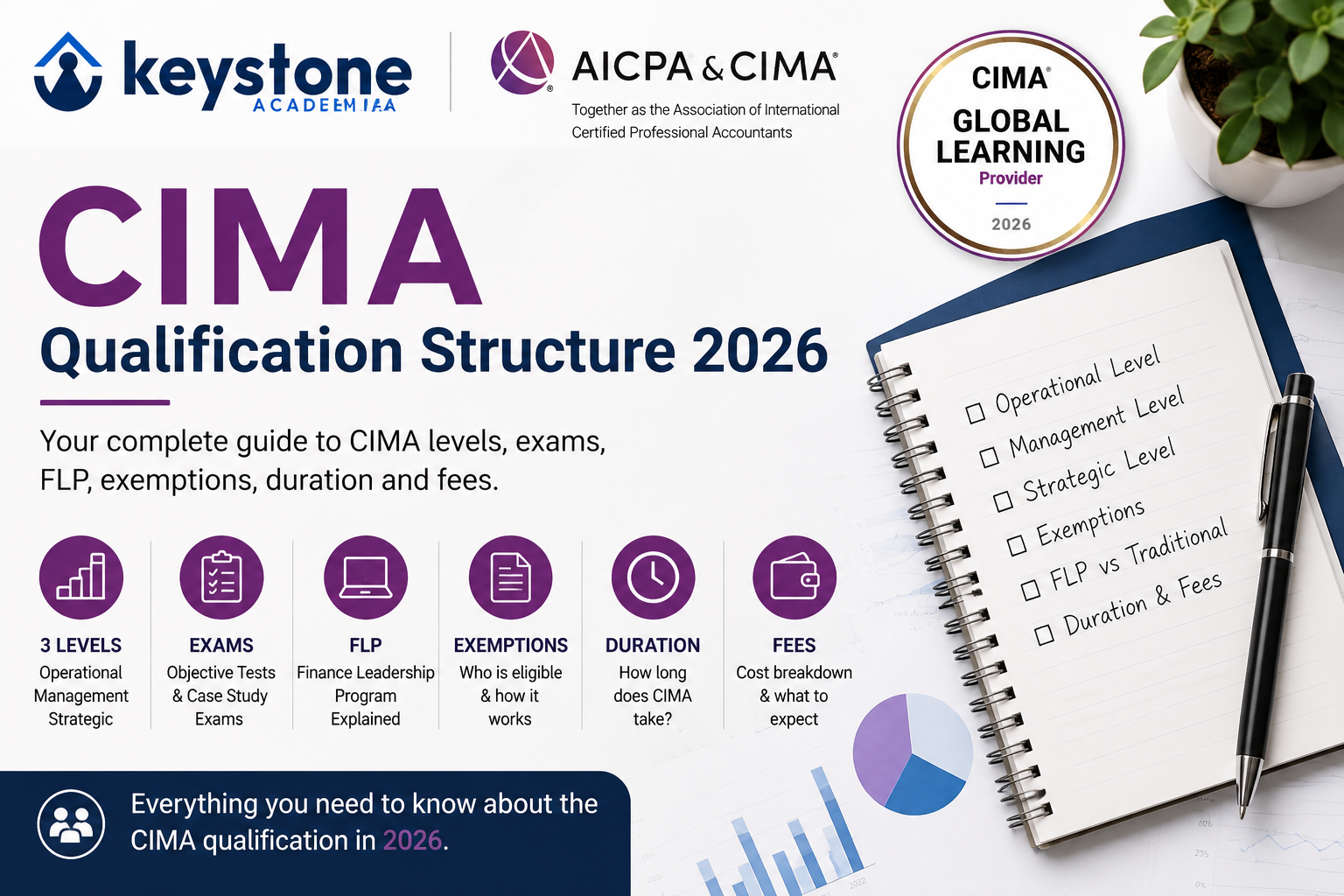
In this guide, we will explain the CIMA qualification structure in 2026 in simple terms, including the different CIMA levels, exams, FLP, exemptions, duration, fees and possible routes for experienced finance professionals.
CIMA Qualification Structure: The Simple Version
The CGMA Professional Qualification has three professional levels:
- Operational Level
- Management Level
- Strategic Level
At each level, the syllabus brings together three areas of finance and business knowledge:
- Enterprise
- Performance
- Financial
If you follow the traditional Self-Tailored pathway, you normally study three subjects at each level and complete their Objective Tests before attempting the relevant Case Study exam.
If you study through the CGMA Finance Leadership Program (FLP), the learning and assessment process is different. Instead of taking the individual Objective Tests, you progress through digital learning and continuous assessments before taking the relevant Case Study exam.
Your actual starting point depends on your previous education, professional qualifications and any exemptions or special entry pathway for which you are eligible.
The Three CIMA Levels Explained
Think of the CIMA qualification as a progression in responsibility.
At Operational Level, you are developing the skills needed to support day-to-day finance and business decisions.
At Management Level, you begin thinking more like a Finance Manager.
At Strategic Level, the focus moves towards the decisions expected from senior finance professionals and business leaders.
That progression is one of the most important things to understand about CIMA.
It is not simply a collection of accounting exams.
The qualification gradually asks you to move from understanding finance to using finance to help run a business.
1. CIMA Operational Level
The CIMA Operational Level is the first level of the CGMA Professional Qualification.
For students following the Self-Tailored pathway, the three subjects are:
E1 – Managing Finance in a Digital World
E1 looks at how organisations operate and how the finance function fits into the wider business.
It also introduces the changing role of finance in a digital environment.
P1 – Management Accounting
P1 focuses on the management accounting techniques businesses use for planning, costing, budgeting, decision-making and performance management.
F1 – Financial Reporting
F1 develops your understanding of financial reporting and how organisations manage financial information and resources.
After completing the requirements of the level, students progress to the Operational Case Study (OCS).
What is the CIMA Operational Case Study?
The OCS brings the subjects together in a business scenario.
Instead of being asked only whether you know a particular accounting concept, you have to show that you can apply your knowledge to a business situation.
This becomes increasingly important as you move through CIMA.
2. CIMA Management Level
The CIMA Management Level is where the qualification starts to feel much closer to the work of a Finance Manager.
Under the Self-Tailored pathway, the subjects are:
E2 – Managing Performance
E2 looks at how organisations, people and projects are managed and how different parts of a business work together to deliver performance.
P2 – Advanced Management Accounting
P2 develops your ability to analyse performance and use management accounting information to support business decisions.
F2 – Advanced Financial Reporting
F2 builds on financial reporting knowledge and develops your ability to understand and analyse more complex financial information.
Students then progress to the Management Case Study (MCS).
What is the CIMA Management Case Study?
The MCS is particularly interesting because the simulated role is broadly that of a Finance Manager.
You are expected to take technical knowledge from E2, P2 and F2 and use it to respond to realistic business problems.
From our experience working with CIMA Case Study students, this is where many candidates initially struggle.
They may know the technical theory very well but still write answers that sound like exam answers rather than advice from a Finance Manager.
A strong MCS answer needs both.
You need the technical knowledge, but you also need to explain:
What does this mean for this particular business?
That shift from remembering theory to applying it commercially is fundamental to CIMA Case Study preparation.
3. CIMA Strategic Level
The CIMA Strategic Level is the final professional level.
At this stage, the perspective changes again.
You are expected to think much more like a senior finance professional involved in strategy, risk and major financial decisions.
The Self-Tailored pathway includes:
E3 – Strategic Management
E3 focuses on strategy and how organisations create and protect long-term value.
P3 – Risk Management
P3 develops your understanding of business risks, controls and how organisations respond to uncertainty.
F3 – Financial Strategy
F3 focuses on major financial decisions, including financing and investment decisions from a strategic perspective.
The level concludes with the Strategic Case Study (SCS).
What is the CIMA Strategic Case Study?
The SCS is the final Case Study exam in the professional qualification.
At this stage, simply demonstrating technical knowledge is not enough.
Candidates are expected to evaluate situations, exercise judgement, consider risks, recommend appropriate actions and communicate from the perspective of senior management.
This is why SCS preparation normally requires a combination of:
- Technical revision
- Pre-seen understanding
- Industry analysis
- Commercial awareness
- Question practice
- Mock exams
- Feedback on answer technique
Passing the SCS is a major milestone in the CIMA journey. Candidates must also meet the applicable practical experience and membership requirements before obtaining the relevant professional designation.
What Are the Enterprise, Performance and Financial Pillars?
You will see the letters E, P and F throughout your CIMA studies.
They represent the three main knowledge pillars.
Enterprise
The Enterprise pillar focuses on how organisations operate, how people and technology contribute to performance, and how strategy is developed and implemented.
Performance
The Performance pillar focuses on management accounting, decision-making, organisational performance and risk.
Financial
The Financial pillar develops financial reporting and financial strategy knowledge.
The Case Study exams then require you to bring knowledge from these different areas together rather than treating them as completely separate subjects.
How Many CIMA Exams Are There?
This is one of the most searched questions about CIMA, but there is no single answer that applies to every student.
If you complete the entire professional qualification through the traditional Self-Tailored pathway without professional-level exemptions, the structure normally includes:
9 Objective Tests + 3 Case Study exams
That gives you 12 professional-level assessments.
However, your personal number could be lower if you receive exemptions.
If you need to begin with the Certificate in Business Accounting, you will have additional assessments before entering the professional qualification.
And if you follow FLP, the assessment structure is different again.
So rather than asking:
How many CIMA exams are there?
A better question is:
How many CIMA exams do I personally need to complete?
Your previous qualifications can make a significant difference.
What Are CIMA Objective Tests?
Objective Tests assess your knowledge of an individual subject such as E1, P2 or F3.
One useful feature of the Self-Tailored pathway is that Objective Tests are generally available on demand.
This gives students flexibility when planning their studies.
Once you have completed the requirements for a level, you can progress towards the relevant Case Study examination.
What Are the CIMA Case Study Exams?
There are three professional-level CIMA Case Study exams:
- Operational Case Study (OCS)
- Management Case Study (MCS)
- Strategic Case Study (SCS)
Case Study exams are different from ordinary knowledge-based assessments.
You are placed into a simulated role within a fictional organisation and asked to respond to business situations.
The exam therefore tests whether you can take what you have learned and actually use it.
This is why students should avoid approaching a Case Study as an exercise in dumping everything they remember about a technical topic.
A good answer normally needs to connect the technical point to:
- The organisation
- The information in the scenario
- The commercial impact
- Risks or opportunities
- An appropriate recommendation
That application is where marks are often won or lost.
What Is the CIMA Pre-Seen?
Before each Case Study exam, CIMA provides information about a fictional organisation. This is commonly called the pre-seen.
It gives candidates context about the organisation and the industry in which it operates.
Good preparation involves understanding areas such as:
- How the organisation makes money
- Its products or services
- Customers
- Competitors
- Industry conditions
- Cost structure
- Key risks
- Strategic challenges
- Relevant technical areas
But there is an important distinction.
Understanding the pre-seen is not the same as predicting the exam.
Students sometimes spend too much time trying to guess the exact questions that could appear.
A better approach is to understand the business deeply enough that you can apply your knowledge when the unseen information appears in the actual exam.
What Is CIMA FLP?
FLP stands for the CGMA Finance Leadership Program.
It is an alternative digital pathway for completing the CGMA Professional Qualification.
The biggest practical difference is the way technical knowledge is assessed.
Self-Tailored pathway
Study the individual E, P and F subjects
→ Complete Objective Tests
→ Attempt the Case Study
→ Progress to the next level
FLP
Work through structured digital learning
→ Complete continuous assessments within the platform
→ Attempt the relevant Case Study
→ Progress to the next level
FLP therefore removes the need to sit the individual Objective Tests used in the traditional Self-Tailored pathway.
The professional-level Case Study exams remain.
CIMA FLP vs Traditional Route: Which Is Better?
Neither route is automatically better.
It depends on the student.
The traditional Self-Tailored pathway may suit you if you prefer individual exams, want control over your study schedule and are comfortable preparing for Objective Tests.
FLP may suit you if you prefer a structured digital learning environment and continuous assessment rather than separate Objective Test examinations.
Before choosing, consider:
- Your learning style
- Current qualifications
- Time available
- Budget
- Work commitments
- Preferred assessment style
Do not choose FLP simply because somebody tells you it is the “easy route.”
And do not choose the traditional pathway simply because that is how CIMA has historically been completed.
Choose the route that makes sense for your circumstances.
Is CIMA FLP Easier?
This is probably the wrong way to compare the two pathways.
FLP removes the separate Objective Test exams and uses continuous assessment through the digital learning platform.
That can make the learning experience more suitable for some candidates.
However, you still need to develop the required knowledge and pass the relevant professional-level Case Study exams.
A better question is:
Which CIMA pathway suits the way I learn and the time I have available?
What Are CIMA Exemptions?
CIMA exemptions can allow eligible candidates to skip certain assessments based on previous recognised qualifications.
This is particularly important if you already have:
- An accounting or finance degree
- Relevant university qualifications
- Another professional accounting qualification
- Certain recognised professional credentials
Your exact exemptions depend on your individual background.
This means two people who decide to start CIMA on the same day may have completely different journeys.
One may need to begin near the start.
Another may be able to enter much further into the qualification.
Always check your official CIMA exemptions before paying for tuition or building your study plan.
How Do I Check My CIMA Exemptions?
Use CIMA’s official exemption and registration process.
You may need to provide evidence of your academic or professional qualifications.
Do not assume that because a colleague received a particular exemption, you will receive exactly the same one.
Eligibility can depend on the exact qualification, institution and other circumstances, and policies can change.
Can Experienced Finance Professionals Fast Track CIMA?
This is particularly relevant to the professionals we work with at Keystone.
If you are already a:
- Finance Manager
- Financial Controller
- Finance Director
- CFO
- Senior Accountant
- Finance Business Partner
- FP&A professional
or hold another recognised professional qualification, do not automatically assume that you need to start CIMA from the beginning.
Depending on your qualifications, professional experience and current CIMA eligibility requirements, there may be an advanced entry or fast-track pathway available.
For a professional who already has significant finance experience, checking this before enrolling can potentially save considerable time.
Already an experienced finance professional?
If you are considering CIMA but are unsure where you would enter the qualification, you can learn more about the pathways available for experienced professionals here:
Learn more about CIMA Fast Track:
https://keystoneacademia.com/cima-for-professionals-fast-track/
Can Work Experience Give You CIMA Exemptions?
Professional experience can be relevant to certain CIMA entry pathways, but years of work experience should not automatically be treated as exam exemptions.
Your eligibility depends on the specific pathway and CIMA’s current requirements.
This is particularly important for people searching for:
- CIMA fast track for Finance Managers
- CIMA for CFOs
- CIMA for Finance Directors
- CIMA exemptions for experienced professionals
- CIMA for senior finance professionals
- Fastest route to CIMA
- CIMA qualification for working professionals
If you already have substantial experience, check your eligibility first rather than assuming either that you must start from the beginning or that your experience automatically exempts you from particular exams.
How Long Does CIMA Take?
The time required to complete CIMA varies significantly.
It depends on:
- Where you start
- Your exemptions
- Your study pathway
- How quickly you progress
- Work and family commitments
- Exam performance
- Case Study exam windows
- Practical experience requirements
Someone starting from the beginning of the qualification cannot realistically be compared with an experienced professional entering at a much more advanced stage.
That is why broad claims such as “CIMA takes three years” can be misleading.
Your first step should be to identify your entry point.
Only then can you estimate a realistic completion timeline.
Can You Complete CIMA in One Year?
For some candidates, yes. For many others, no.
The difference is usually the starting point.
An experienced professional entering through an eligible advanced pathway may have relatively few remaining requirements.
Someone starting from the beginning has a much longer journey.
If speed matters to you, don’t begin by searching for shortcuts.
Begin by finding out exactly where CIMA allows you to enter based on your qualifications and experience.
How Long Does CIMA Take for Working Professionals?
Working professionals face a different challenge from full-time students.
Your CIMA study plan has to survive:
- Month-end
- Year-end
- Budget season
- Work travel
- Long working hours
- Family commitments
- Unexpected deadlines
We often see professionals become overly aggressive with their first study plan and then struggle to maintain it.
A realistic plan that you can consistently follow is usually more valuable than the fastest possible plan on paper.
If you already have substantial finance experience or professional qualifications, check your exemptions and potential entry route before estimating how long CIMA will take you.
How Much Does CIMA Cost in 2026?
There is no single total price for completing CIMA.
Your cost can include:
- Registration
- Candidate subscriptions
- Objective Test fees
- Case Study exam fees
- FLP fees, if you choose that pathway
- Tuition
- Study materials
- Resits, if required
Costs can also vary by location and pathway.
For that reason, we recommend checking the latest official CIMA website or by registering with us for fee information before making a budget.
This is particularly important for an evergreen guide because professional body fees can change over time.
What Is the Total Cost of CIMA?
Your total CIMA cost depends largely on how much of the qualification you actually need to complete.
For example, someone completing all three professional levels through the Self-Tailored pathway will have a different cost from someone who receives substantial exemptions.
FLP also uses a different pricing structure.
Tuition is another variable.
And if an exam needs to be retaken, that naturally affects the total cost.
Instead of looking for one universal CIMA price online, calculate:
Your entry point + your pathway + your remaining assessments + learning support = a much more realistic estimate of your CIMA cost.
Understand more about CIMA Fees: https://keystoneacademia.com/cima-for-professionals-fast-track/
Which CIMA Route Should You Choose?
If you are still unsure, start with your current situation.
I am new to finance
Look at the standard entry requirements and build the technical foundation properly.
I already have a relevant degree
Check your exemptions before deciding where to begin.
I prefer continuous digital learning
Compare FLP with the Self-Tailored pathway.
I already hold another professional qualification
Check whether it gives you exemptions or access to a specific pathway.
I am already a Finance Manager, Controller, Finance Director or CFO
Investigate the routes available to experienced professionals before assuming you need to complete the full journey.
That one step can completely change your CIMA plan.
Frequently Asked Questions About CIMA Levels, Exams and FLP
How many levels does CIMA have?
The CGMA Professional Qualification has three professional levels: Operational, Management and Strategic. Depending on your educational background, you may need to complete the Certificate in Business Accounting before entering the professional qualification.
What are the CIMA Operational Level subjects?
Under the Self-Tailored pathway, the Operational Level includes E1, P1 and F1 followed by the Operational Case Study.
What are the CIMA Management Level subjects?
The Management Level includes E2, P2 and F2 followed by the Management Case Study.
What are the CIMA Strategic Level subjects?
The Strategic Level includes E3, P3 and F3 followed by the Strategic Case Study.
How many CIMA Case Study exams are there?
There are three professional-level Case Study exams: OCS, MCS and SCS.
How many CIMA exams will I need to take?
It depends on your entry point, exemptions and study pathway. Someone completing the full professional qualification through the Self-Tailored pathway without professional-level exemptions would normally complete nine Objective Tests and three Case Study exams.
Can I study CIMA while working full time?
Yes. Many CIMA candidates study while working full time. The important part is choosing a realistic study schedule and a pathway that fits around your professional and personal commitments.
What is CIMA FLP?
The CGMA Finance Leadership Program is a digital pathway to the CGMA Professional Qualification. Learning and continuous assessments are completed through the platform instead of sitting the individual Objective Tests used in the Self-Tailored pathway. Professional-level Case Study exams remain.
Is CIMA FLP easier than the traditional route?
Not necessarily. The assessment method is different. FLP may suit some learning styles better, but candidates still need to develop the required competencies and pass the relevant Case Study examinations.
Can I get exemptions from CIMA?
Possibly. Exemptions depend on your previous academic and professional qualifications. You should check your individual eligibility through CIMA rather than relying on another candidate’s experience.
Can a Finance Manager fast track CIMA?
Potentially, depending on the person’s qualifications, experience and the eligibility requirements of the available CIMA pathways. Experienced Finance Managers should check their entry route before assuming they need to begin from the first level.
Can a CFO study CIMA?
Yes. CIMA can also be relevant to senior finance professionals seeking a recognised professional designation. Depending on their background, CFOs and Finance Directors should investigate whether an experienced-professional pathway is available to them.
Can I complete CIMA online?
Much of the learning can be completed online through self-study, online tuition or FLP. Examination and assessment arrangements depend on the pathway and current CIMA requirements.
How long does CIMA take?
There is no universal completion time. It depends heavily on your starting point, exemptions, pathway, study pace and exam performance.
Can CIMA be completed in one year?
It may be possible for candidates entering at an advanced stage, but it would not be realistic to present one year as a standard completion time for everyone. Your individual entry route determines what you still need to complete.
Before You Start CIMA
Before you spend money on tuition or create an exam timetable, answer seven questions:
- Where am I eligible to enter CIMA?
- What exemptions do I have?
- Should I choose Self-Tailored or FLP?
- How many assessments do I actually need?
- How much time can I realistically commit each week?
- What will my complete journey cost?
- Does CIMA support the career I am trying to build?
For experienced professionals, the first two questions are particularly important.
You may already have years of finance experience behind you. Your qualification journey should take account of that experience and any relevant professional credentials rather than automatically following the same route as someone just entering finance.
CIMA Fast Track for Experienced Finance Professionals
If you are a Finance Manager, Financial Controller, Finance Director, CFO or experienced finance professional, your CIMA journey may be different from the standard route.
Keystone Academia works with experienced finance professionals pursuing CIMA and can help you understand the relevant pathway and prepare for the Case Study requirements that apply to you.
Learn more about CIMA Fast Track:
https://keystoneacademia.com/cima-for-professionals-fast-track/
Qualification structures, exemptions, pathways, fees and eligibility requirements can change. Always confirm your individual position and the latest requirements directly with CIMA before registering or making a financial decision.