

Preparing for the CIMA Management Case Study August 2026 exam is not only about learning E2, P2 and F2.
The bigger challenge is learning how to take that knowledge and apply it properly to Cartn, the August 2026 MCS pre-seen company.
You may know the correct theory.
You may identify the right risk.
You may even give a sensible recommendation.
But that still does not automatically make it a strong CIMA MCS answer.
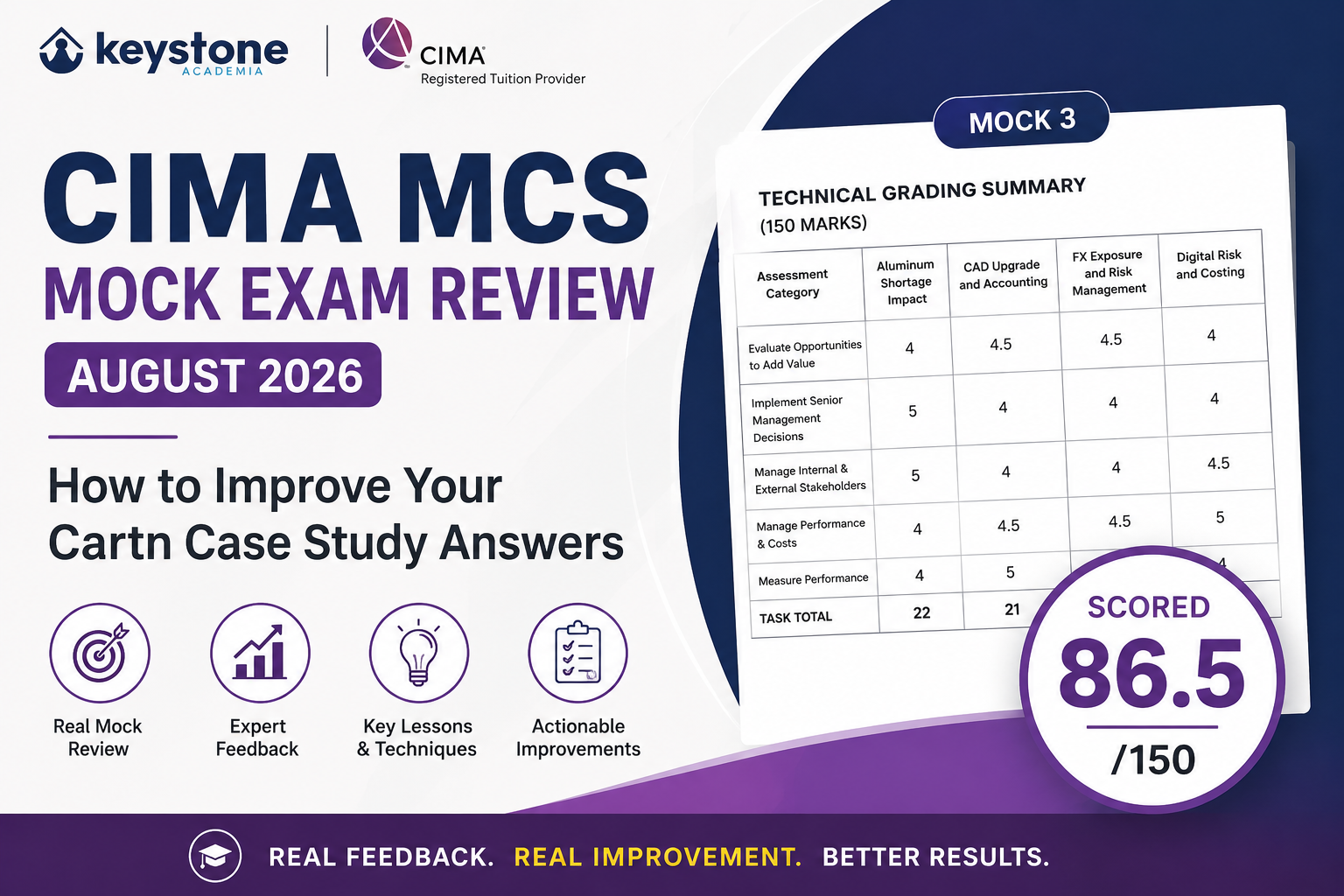
In this article, we review a real Keystone Academia CIMA MCS Mock 3 submission that scored 86.5 out of 150.
The mock covered four important Cartn areas:
- aluminium shortage and operational impact
- CAD upgrade and accounting treatment
- staff resistance and change management
- foreign exchange exposure and risk management
- digital risk
- costing and performance management
The student showed good technical understanding and commercial awareness. The main improvement area was not learning more theory. It was going deeper with the points already identified.
The feedback repeatedly asked for more:
application, implementation, metrics, governance, controls and commercial impact.
That makes this mock particularly useful for CIMA MCS students because it shows the difference between a reasonable answer and a stronger case study answer.
Useful Resources Free CIMA MCS Mock Exam https://keystoneacademia.com/cima-mcs/
Join our CIMA WhatsApp Community https://chat.whatsapp.com/IO9crOukZzoJ3SzGxu8MS3?mode=gi_t
Visit Keystone Academia https://keystoneacademia.com/
What was the biggest weakness in this CIMA MCS mock?
The student usually identified the correct issue.
That was not the main problem.
The bigger problem was what happened after the issue was identified.
The final mock feedback described the submission as relevant, well structured and commercially focused. It also recognised good understanding of major risks, accounting treatments, financial management and cross-functional decision-making.
However, several points needed more specificity and stronger application to Cartn, particularly around:
- implementation
- governance
- controls
- performance measurement
- practical business implications
This is one of the most important lessons for anyone preparing for the CIMA MCS August 2026 Cartn exam.
Do not stop after making a correct point.
Ask yourself:
How would Cartn actually do this?
How do you add depth to a CIMA MCS answer?
A common CIMA MCS mistake is writing something like:
Finance should prepare forecasts.
There is nothing technically wrong with that.
But it is very broad.
In the aluminium-shortage task, the student recommended that Finance prepare production and cost forecasts so Operations could prioritise manufacturing based on available materials and demand.
The recommendation was relevant.
However, the mock feedback asked for more detail around:
- forecasting methods
- scenario analysis
- KPIs
- communication with Operations
- how the information would support actual decisions
A stronger answer could look like this:
Finance should prepare rolling production and cost forecasts showing aluminium availability, customer demand, production capacity and expected material prices.
That is already better.
But we can develop it further:
Finance could prepare expected, downside and severe-shortage scenarios showing the impact on production volumes, margins and cash flow. Operations could then use this information to prioritise scarce production capacity, while Marketing communicates revised delivery expectations to customers.
Now the answer is doing much more.
It tells management:
what to do → how to do it → why it matters → what decision it supports.
That is the type of depth students should aim for in CIMA MCS.
CIMA MCS answer technique: Identify, apply, analyse and recommend
One simple way to improve your CIMA Management Case Study answers is to build each important point in stages.
1. Identify the issue
What is happening?
2. Apply it to Cartn
Why does this issue matter specifically to Cartn?
3. Analyse the impact
What are the financial, operational, customer or strategic consequences?
4. Recommend an action
What should management do?
5. Explain implementation
How would the recommendation actually work?
6. Measure it
What information or KPIs should management monitor?
7. Add controls and governance
Who should be responsible and how should management oversee the action?
8. Evaluate the downside
What are the costs, limitations or risks of your recommendation?
You will not necessarily use all eight steps in every paragraph.
But thinking this way helps stop your answer becoming descriptive.
Lesson 1: Apply your CIMA MCS answer directly to Cartn
Generic business advice is rarely enough.
The examiner needs to see that you understand the case organisation.
During the aluminium shortage discussion, the student recommended prioritising customers based on profitability and strategic importance.
That is a sensible recommendation.
However, the feedback noted that the student could have explained the criteria used to determine customer profitability and strategic importance.
For Cartn, the analysis could consider:
- contribution from the customer
- profitability of individual contracts
- long-term customer value
- strategic importance
- contractual penalties
- strength of the customer relationship
- future revenue opportunities
- availability of alternative suppliers
- impact on customer production
Instead of writing:
Cartn should prioritise important customers.
A stronger answer explains:
which customers Cartn should prioritise and why.
That is what commercial application looks like.
Lesson 2: Explain how your recommendation will be implemented
Another strong idea in the mock was creating a cross-functional team involving:
- Finance
- Operations
- Procurement
- Marketing
The student proposed that the team regularly review aluminium supply, customer demand, production capacity, profitability and financial forecasts.
This was a good commercial recommendation.
But the feedback wanted more discussion of:
- responsibilities of each department
- frequency of meetings
- how decisions would be made
- information and metrics used
- communication between departments
- how conflicting priorities would be resolved
This shows why simply writing:
Create a cross-functional team
is not enough.
Take it one level further.
For example:
Finance could provide margin and cash-flow analysis, Procurement could report supplier availability, Operations could provide production-capacity information and Marketing could identify strategically important customers.
Then explain the decision:
The team could meet weekly during the shortage and agree production priorities based on customer importance, contribution and contractual obligations.
That becomes much more practical.
Lesson 3: Technical knowledge needs commercial application
Task 2 covered the accounting treatment of the CAD upgrade.
The student correctly recommended capitalising qualifying CAD software licences as intangible assets.
The student also explained that the asset should be amortised over its useful life.
The feedback recognised this as broadly consistent with IAS 38, but suggested stronger reference to the recognition criteria and consideration of impairment indicators.
This is important for CIMA MCS students.
Knowing the accounting treatment is the starting point.
A stronger answer goes beyond:
Capitalise this.
It should also explain:
- why the treatment is appropriate
- the effect on the financial statements
- how future amortisation affects profit
- what costs should remain expenses
- how Finance should control project expenditure
- why the treatment matters to management
The student also suggested separate project cost codes for software licences, development expenditure and training costs.
That was a good practical recommendation.
The feedback suggested linking it more clearly to benefits such as budget control, accurate reporting and easier audit review.
That final link is often what improves the answer.
Lesson 4: CIMA MCS change management answers need to explain behaviour
The CAD implementation also created resistance among experienced engineers.
The student recommended:
- communicating the benefits
- involving experienced engineers
- providing training
- providing continued support
- using change champions
These were all relevant.
One particularly useful recommendation was involving senior engineers in testing the new CAD software and developing the implementation plan.
The feedback agreed that this could increase acceptance and help identify operational problems early.
However, it also suggested analysing why those employees might resist the change, including concerns about their expertise, status or future responsibilities.
This is where stronger CIMA MCS answers separate themselves.
Do not only say:
Employees may resist change.
Explain why.
For example:
Experienced engineers may feel that the new CAD software reduces the value of the specialist knowledge they have built over many years.
Management could therefore involve them in the implementation process and give them responsibility for testing, training or supporting colleagues.
That makes the response more realistic.
Lesson 5: Use change champions properly
The student also recommended using respected engineers as change champions.
The idea is strong because employees may accept a new system more readily when support comes from trusted colleagues rather than only senior management.
However, the feedback suggested explaining:
- how change champions would be selected
- how they would be trained
- how their role would fit into the organisation
A stronger answer could say:
Cartn could select respected senior engineers from each regional team and train them before the wider rollout. These employees could demonstrate the system, provide informal support and communicate concerns back to management.
You could also evaluate the downside:
However, management should select the champions carefully because an influential employee who remains negative about the system could increase resistance among other engineers.
Now the answer contains both recommendation and evaluation.
Lesson 6: CIMA MCS foreign exchange answers need a business impact
Task 3 covered foreign exchange risk.
The student correctly explained the translation of overseas subsidiaries and the effect of exchange differences on the currency translation reserve.
The mock feedback recognised the technical understanding but suggested more discussion of how translation differences could affect:
- financial reporting
- management interpretation
- stakeholder perception
- financial decision-making
This is another common CIMA MCS issue.
Students often explain the technical accounting correctly and then stop.
Always ask:
So what does this mean for the business?
For example:
A movement in the currency translation reserve does not necessarily represent a cash gain or loss.
Management may therefore need to explain significant movements clearly to stakeholders so they are not interpreted as changes in Cartn’s underlying operational performance.
That is a much more commercially useful point.
Lesson 7: Do not simply say Cartn should hedge its foreign exchange risk
The student recommended a forward exchange contract for a foreign-currency supplier payment due in 90 days.
This was one of the stronger recommendations in the mock.
The answer explained that using a forward contract could provide certainty over the eventual cost of the aluminium.
It also made the important link to Cartn’s fixed-price customer contracts. If exchange rates increased the material cost, Cartn may not always be able to pass that increase to customers.
The student also recognised that Cartn could lose the benefit of favourable exchange-rate movements.
The feedback nevertheless suggested taking the answer further by discussing:
- financial reporting implications
- hedge effectiveness
- treasury involvement
- approval and governance
A strong CIMA MCS risk-management answer should therefore think about:
Risk → impact → response → cost → downside → control → monitoring.
Not just:
There is FX risk, therefore use a forward contract.
Lesson 8: Connect financial analysis to management decisions
The student recommended monitoring the effect of exchange-rate movements on Cartn’s product margins.
This is particularly relevant where Cartn has fixed-price contracts.
If aluminium costs increase because of currency movements, Cartn may have to absorb some or all of the additional cost.
The feedback suggested explaining how this information would be forecast, reviewed regularly and incorporated into pricing and control decisions.
A useful question for every CIMA MCS student is:
What will management do differently because Finance produced this analysis?
For example, Cartn might:
- renegotiate future customer contracts
- introduce FX clauses in future agreements
- hedge significant exposures
- review suppliers
- change future prices
- alter production priorities
- accept lower margins for strategically important customers
Financial analysis becomes much stronger when you connect it to a decision.
Lesson 9: Digital risk answers need financial consequences
Task 4 covered digital risk arising from increased use of:
- CAD systems
- cloud storage
- supplier platforms
- remote access
The student identified several relevant risks:
- data breaches
- ransomware
- system outages
- loss of sensitive customer information
The mock feedback accepted these risks but suggested stronger application to Cartn and deeper discussion of financial consequences.
For example, do not stop at:
A cyberattack could damage Cartn’s reputation.
Explain what happens next.
A cyberattack could prevent engineers from accessing CAD files.
That could delay client projects.
Project delays could create:
- contractual penalties
- additional employee costs
- lost consultancy revenue
- recovery expenses
- customer dissatisfaction
- loss of future contracts
That is much stronger analysis.
Lesson 10: CIMA MCS cybersecurity controls need governance
The student recommended several relevant controls, including:
- restricting access to sensitive information
- regular backups
- user-access reviews
- cybersecurity monitoring
- testing recovery procedures
The feedback agreed with these controls but suggested discussing implementation, costs, operational impact and management acceptance.
Whenever you recommend a control in CIMA MCS, think about:
Who owns it?
How often is it performed?
Who reviews the results?
What happens when a problem is identified?
How much does the control cost?
Could the control create operational delays?
Controls should be proportionate to the risk.
That gives your answer a more senior-management perspective.
Lesson 11: Do not simply list KPIs
The student suggested several useful performance measures for Cartn’s consultancy projects:
- engineering hours per project
- actual cost compared with budget
- project profit margin
- number of customer revisions
- revenue per engineering hour
These were good KPIs.
The feedback suggested going further by explaining how the measures would fit into Cartn’s wider performance-management system and how they would be controlled and monitored.
Again, ask:
What will management learn from this KPI?
For example:
If engineering hours regularly exceed budget, management could investigate whether:
- the original project estimate was inaccurate
- customers are requesting excessive revisions
- employees require additional training
- the project has been poorly managed
- Cartn’s pricing model needs changing
Now the KPI supports an actual management decision.
A simple CIMA MCS answer-writing framework
When writing your CIMA MCS August 2026 exam answers, try this simple sequence:
Point
What is the issue or recommendation?
Cartn
Why is it relevant specifically to Cartn?
Impact
What happens financially, operationally or strategically?
Action
What should management do?
Implementation
How will the action work?
Measurement
How will management know whether it is working?
Control
Who should oversee it and what controls are needed?
Evaluation
What could go wrong or what is the downside?
You do not have to mechanically write all eight elements every time.
Use them as prompts when your answer feels too short or generic.
Example: Basic CIMA MCS answer vs stronger answer
Consider foreign exchange exposure.
Basic answer
Cartn should prepare a cash-flow forecast because the supplier must be paid in 90 days.
Better answer
Cartn should prepare a rolling cash-flow forecast showing the expected foreign-currency payment and the cash requirement based on current exchange rates.
Stronger answer
Finance should prepare a rolling 90-day cash-flow forecast incorporating the foreign-currency supplier payment.
The forecast could include expected and adverse exchange-rate scenarios so management can understand the possible liquidity requirement if the supplier currency strengthens.
Finance should update the forecast regularly and compare the unhedged exposure with any forward contracts already entered into.
This would allow Cartn to identify liquidity pressure early and determine whether additional hedging or working-capital arrangements are necessary.
The original mock answer already used expected and adverse exchange-rate scenarios, which was a strong starting point.
The improvement is taking the point further and explaining how management would use the information.
What did the student do well in this CIMA MCS mock?
The purpose of reviewing a mock is not simply to find mistakes.
There were several positive features in this submission.
The final feedback recognised that the student demonstrated:
- sound technical knowledge
- commercial thinking
- relevant answers
- generally good structure
- understanding of risk
- appropriate accounting treatment
- financial-management awareness
- cross-functional thinking
- links between Finance and business decision-making
The student scored 86.5/150 in this Keystone Academia Mock 3 assessment.
The main opportunity was therefore not simply learning more content.
It was developing the content already known into stronger commercial analysis.
What is a good CIMA MCS answer?
A good CIMA Management Case Study answer should not read like a textbook.
It should read like advice from a Finance Manager inside the case organisation.
That means your answer should normally be:
Relevant
Answer the requirement directly.
Applied
Use the facts and circumstances of Cartn.
Commercial
Think about customers, profitability, cash flow, employees, operations and strategy.
Practical
Explain what management should actually do.
Balanced
Recognise disadvantages, costs and implementation difficulties.
Specific
Avoid vague recommendations such as “improve communication” or “monitor performance” without explaining how.
What does commercial awareness mean in CIMA MCS?
Commercial awareness means looking beyond the technical rule.
For example, a student may correctly calculate or identify an increase in aluminium costs.
Commercial awareness asks:
- Can Cartn pass the additional cost to customers?
- Are contracts fixed price?
- Could customers move to competitors?
- Which products have low margins?
- Should some customers receive priority?
- What happens to working capital?
- What happens to cash flow?
- Could production delays damage future relationships?
This is how CIMA theory becomes management advice.
How do I use the Cartn pre-seen in my CIMA MCS answer?
Do not force pre-seen facts into every paragraph.
Use them when they genuinely strengthen your analysis.
Your objective is to show that the recommendation is designed for Cartn, not for any random company.
For example:
Instead of:
Foreign exchange movements could reduce margins.
You might explain:
Foreign exchange movements could be particularly important where Cartn is purchasing aluminium from an overseas supplier while selling under fixed-price customer contracts, because additional input costs may not be recoverable immediately.
That is much stronger application.
What is the difference between description and analysis in CIMA MCS?
Description tells the reader what something is.
Analysis explains:
why it matters, what happens because of it and what management should do about it.
For example:
Description
A forward contract fixes an exchange rate for a future transaction.
Analysis
A forward contract could give Cartn certainty over the domestic-currency cost of its 90-day supplier payment, reducing the risk that an adverse exchange-rate movement damages already tight product margins.
However, Cartn would lose the opportunity to benefit fully if the supplier currency weakens.
The second version is far more useful to management.
How do I improve after completing a CIMA MCS mock exam?
Do not only look at your total mock score.
Analyse your feedback.
For every point where your tutor says:
- needs more depth
- too generic
- more application required
- explain further
- develop the recommendation
- consider implementation
- add governance
- discuss the impact
rewrite that paragraph.
Try to improve the same answer rather than immediately moving to another mock.
This helps you develop CIMA MCS answer-writing technique, not simply practise typing more answers.
CIMA MCS August 2026 Cartn: Key lessons from this mock
This particular mock highlights several areas students may want to practise before the August 2026 exam:
- aluminium shortage and supply-chain risk
- customer prioritisation
- rolling forecasts
- scenario analysis
- variance analysis
- working-capital management
- CAD system implementation
- IAS 38 and intangible assets
- research and development expenditure
- staff training costs
- managing resistance to change
- change champions
- foreign-currency exposure
- IAS 21
- currency translation
- forward exchange contracts
- cash-flow forecasting
- product-margin protection
- digital risk
- cybersecurity
- business continuity
- activity-based costing
- project costing
- pricing decisions
- resource allocation
- performance measurement and KPIs
The important point is not to predict that these exact requirements will appear.
Use them as opportunities to practise applying E2, P2 and F2 knowledge to Cartn.
Final takeaway
The biggest lesson from this CIMA MCS mock is simple:
Do not stop when you reach the correct point.
Keep going.
Ask:
Why does this matter to Cartn?
What happens because of it?
What should Finance do?
How would it be implemented?
Who should be responsible?
What should management measure?
What controls are required?
What is the downside?
The difference between an average CIMA MCS answer and a stronger answer is often not learning another model or another theory.
It is taking the knowledge you already have and turning it into specific, practical and commercially useful advice for the case organisation.
For students preparing for the CIMA MCS August 2026 Cartn case study, that should be one of the main objectives of every remaining mock exam.
Frequently Asked Questions About CIMA MCS Mock Exams
How do I add more depth to my CIMA MCS answer?
After making a point, explain why it matters to Cartn, the financial or operational impact, what management should do, how the recommendation should be implemented and how success should be monitored.
How should I structure a CIMA MCS answer?
There is no need to force every paragraph into one rigid structure. A useful approach is to move from the issue to application, impact, recommendation and implementation.
How do I apply the Cartn pre-seen in the exam?
Use relevant Cartn facts to explain why a particular risk, opportunity or recommendation matters. Avoid simply repeating facts from the pre-seen without analysing them.
How can I improve my CIMA MCS commercial analysis?
Think about the effect of your recommendation on profitability, cash flow, customers, employees, operations, risk and long-term strategy.
What are common CIMA MCS answer-writing mistakes?
Common issues include writing generic theory, failing to apply the answer to the case company, listing recommendations without explaining implementation, failing to evaluate disadvantages and not linking financial analysis to management decisions.
Should I use KPIs in a CIMA MCS answer?
Use KPIs when they genuinely help management monitor an issue or recommendation. Explain what the KPI measures and what management would do if performance moves away from expectations.
How important is governance in CIMA MCS?
Governance can add useful depth when discussing major risks, controls, investment decisions, treasury, cybersecurity or large organisational changes. Explain who owns the decision and how it should be monitored.
How do I improve after getting CIMA MCS mock feedback?
Do not only read the comments. Rewrite weaker paragraphs using the feedback. This is one of the best ways to improve your application, analysis and recommendation skills before the real exam.
Can a technically correct CIMA MCS answer still be weak?
Yes. Correct technical knowledge is important, but the answer can still lack application, commercial impact, implementation or evaluation. This mock is a good example of why developing each correct point further matters.