
Preparing for the CIMA Strategic Case Study (SCS) can feel overwhelming.
Unlike objective tests, the Strategic Case Study is designed to assess how well you think as a senior finance professional. Success depends on much more than technical knowledge. You must analyse business issues, evaluate strategic options, assess risks, interpret financial information and communicate commercially sound recommendations to the Board.
Every year, students ask the same questions:
- How should I study the pre-seen?
- How many mock exams should I complete?
- What separates a pass from a high score?
- How should I tackle unseen information?
- How do I develop a strategic mindset?
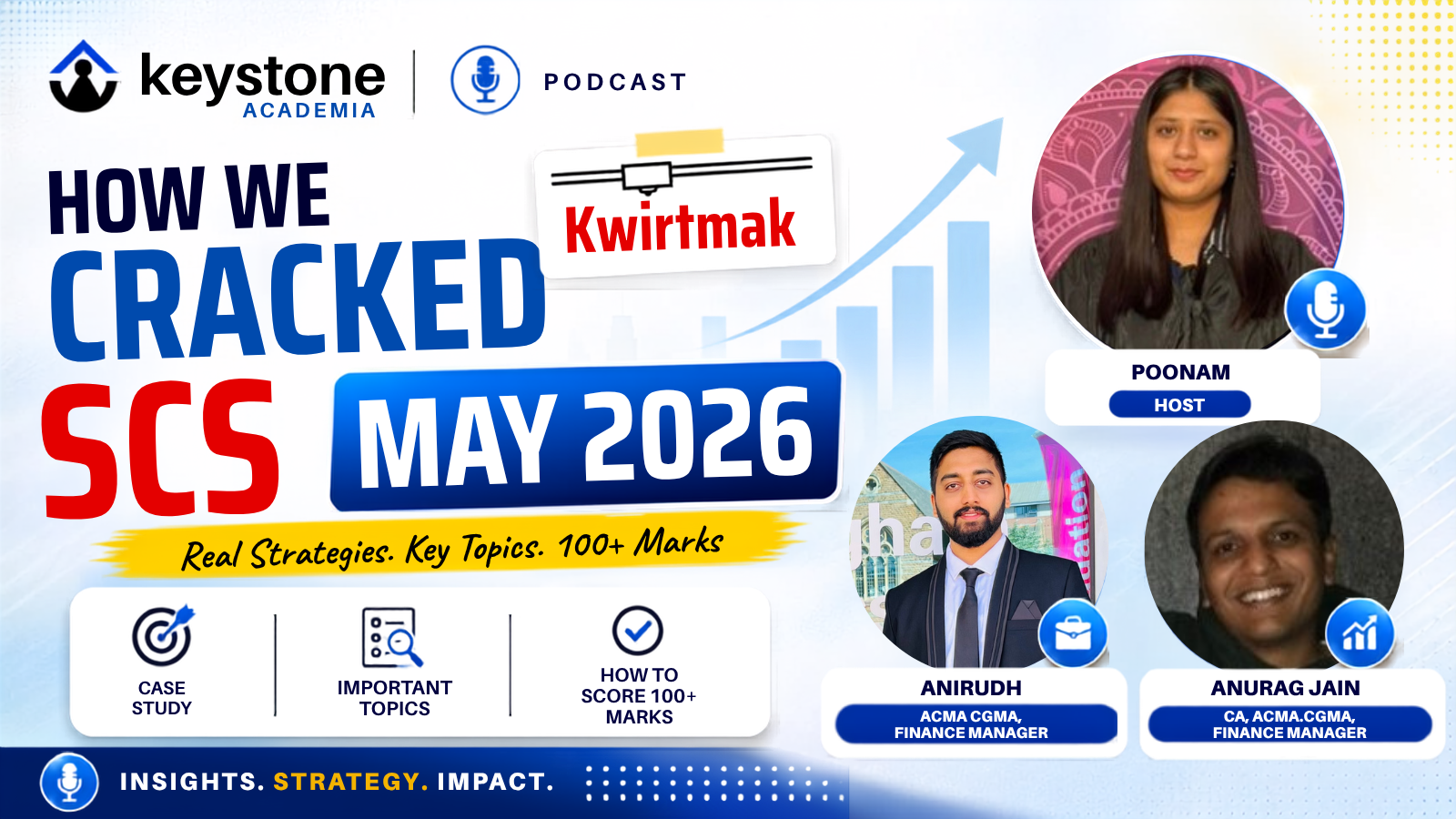
To answer these questions, Keystone Academia interviewed two students who successfully passed the May 2026 CIMA Strategic Case Study, achieving impressive scores of 103 and 89. Their preparation strategies are particularly valuable for students preparing for the August 2026 Strategic Case Study, as both sittings use the same Kwirtmak pre-seen, while the broader lessons remain relevant for every future CIMA Strategic Case Study candidate.
This article brings together the most valuable insights from their experience and transforms them into practical lessons you can apply throughout your own SCS preparation.
Why Listen to Students Who Have Already Passed?
There is no substitute for learning from candidates who have recently succeeded.
Both students balanced full-time employment with their studies, followed a structured preparation plan, completed multiple mock exams and consistently refined their approach through detailed feedback.
Their success demonstrates that passing the Strategic Case Study is not about memorising textbook theory. It is about developing commercial judgement, applying technical knowledge within the business context and thinking like a Senior Finance Manager.
If you are preparing for the August 2026 examination or any future Strategic Case Study sitting, these lessons can significantly improve your preparation.
Lesson 1: Master the Pre-seen Before Anything Else
Both students agreed on one point from the very beginning:
The pre-seen is the foundation of your preparation.
Rather than reading it once or twice, they revisited it continuously throughout their studies.
Instead of viewing the pre-seen as a document to memorise, they analysed it like senior managers preparing for a Board meeting.
They organised the information into categories such as:
- Business model
- Industry overview
- Products and services
- Competitors
- Strategic objectives
- Financial performance
- Principal risks
- Governance
- Sustainability
- Stakeholders
By repeatedly reviewing these areas, they developed a deep understanding of the company and its commercial environment.
For August 2026 students, this means developing an in-depth understanding of Kwirtmak, the commercial 3D printing industry, its competitive landscape and the company’s strategic challenges before focusing heavily on technical revision.
Lesson 2: Stop Thinking Like a Student
One message appeared repeatedly throughout the interview.
“Don’t think like a student.”
The Strategic Case Study expects candidates to think as senior finance professionals.
Every recommendation should reflect the perspective of someone advising the Board rather than answering an academic examination.
Before writing any answer, ask yourself:
- What decision does the Board need to make?
- What risks should management consider?
- What are the financial implications?
- Which stakeholders are affected?
- What would create long-term value?
This mindset shift is often what separates average answers from high-scoring responses.
Lesson 3: Understand the Business Before Revising the Syllabus
Many candidates spend months revising E3, P3 and F3 but only a few hours analysing the company.
The students recommended the opposite approach.
They first focused on understanding:
- How the company generates revenue
- Customer segments
- Competitive advantages
- Industry trends
- Strategic risks
- Financial performance
- Future opportunities
Only after understanding the business did they integrate technical knowledge from E3, P3 and F3.
This approach produces commercially focused answers rather than generic textbook responses.
Lesson 4: Mock Exams Are the Biggest Difference Between Passing and Excelling
One student openly admitted that he had previously underestimated mock exams.
For his successful attempt, mock practice became his highest priority.
Mock examinations helped him:
- improve answer structure
- develop time management
- apply technical knowledge
- strengthen recommendations
- build confidence under exam conditions
Completing mock exams is not simply about practising questions.
It is about learning how to think, prioritise and communicate under pressure.
Lesson 5: Financial Analysis Should Support Every Recommendation
One of the biggest improvements identified through mock feedback was the use of financial evidence.
Initially, recommendations relied heavily on discussion.
Later, they became supported by financial analysis.
Strong Strategic Case Study answers explain:
- what the numbers indicate
- why they matter strategically
- how they affect decision making
- what actions the Board should take
Recommendations become significantly stronger when they are supported by commercial and financial evidence.
Lesson 6: Explain, Don’t Just Identify
Many candidates lose marks by simply identifying issues.
High-scoring students go further.
Instead of writing:
“This is a risk.”
Explain:
- Why it is a risk
- Why it matters now
- Which stakeholders are affected
- The financial implications
- The strategic consequences
- The recommended action
The examiner rewards commercial reasoning rather than simple identification.
Lesson 7: Working Professionals Can Still Succeed
Both interviewees prepared while working full time.
Their advice was practical rather than unrealistic.
They recommended:
- studying consistently every day
- using commuting time productively
- listening to recorded classes
- maximising weekends
- planning revision months in advance
Consistency proved more valuable than occasional intensive study sessions.
Lesson 8: Create One Master Revision Resource
As the examination approached, both students relied on a single revision resource.
One created an Excel workbook.
The other developed a comprehensive mind map.
Both served the same purpose:
A single document containing:
- risks
- financial analysis
- stakeholder information
- strategic themes
- governance issues
- industry analysis
- key revision notes
This allowed them to revise efficiently during the final week without constantly switching between different resources.
Lesson 9: The Final Week Is About Refinement, Not New Learning
Trying to learn new material during the final week often creates unnecessary anxiety.
Instead, successful students focused on:
- reviewing mock feedback
- refreshing financial analysis
- revisiting key risks
- revising Board members
- reviewing strategic themes
- strengthening answer quality
Confidence comes from reinforcement rather than information overload.
Lesson 10: Stay Calm on Exam Day
Their advice for exam day was refreshingly simple.
- Get enough sleep.
- Eat properly before the exam.
- Stay hydrated.
- Avoid panic revision.
- Remain calm.
One student even described taking a brief pause every thirty minutes to reset mentally before continuing with the next question.
Maintaining composure helped sustain concentration throughout the three-hour examination.
Lesson 11: The Unseen Information Should Not Be Feared
Many students worry about the unseen information.
The interviewees viewed it differently.
If you genuinely understand the business, the unseen simply provides additional context.
Whenever they encountered unseen information, they immediately considered:
- What is the real issue?
- Which stakeholders are affected?
- What are the financial implications?
- What risks have emerged?
- What recommendation should be made?
This structured approach helped them remain calm even when unfamiliar scenarios appeared.
Lesson 12: Passing SCS Changes How You Think
Perhaps the most powerful insight came after they had passed.
Both students explained that Strategic Case Study preparation changed how they approached their professional roles.
Instead of simply presenting financial information, they now focused on:
- interpreting business performance
- supporting decision making
- communicating strategically
- linking finance with business objectives
- thinking beyond numbers
This is exactly what employers expect from qualified management accountants.
The Strategic Case Study is therefore much more than an examination—it is preparation for senior leadership.
Common Mistakes to Avoid
Throughout the interview, several recurring mistakes emerged.
Avoid these if you want to maximise your chances of success:
- Memorising theory instead of understanding the business
- Ignoring financial analysis
- Completing too few mock exams
- Writing textbook answers
- Forgetting stakeholder impacts
- Providing weak recommendations
- Trying to learn everything during the final week
- Poor time management
- Failing to think commercially
Final Thoughts
Every Strategic Case Study sitting introduces different industries, different businesses and different unseen scenarios.
However, the principles behind success remain remarkably consistent.
The students interviewed by Keystone Academia did not succeed because they memorised more theory than everyone else.
They succeeded because they:
- understood the business
- analysed strategic issues
- integrated E3, P3 and F3 knowledge
- completed realistic mock exams
- improved through feedback
- thought like Senior Finance Managers
- communicated commercially
Whether you are preparing for the August 2026 Strategic Case Study using the Kwirtmak pre-seen, or planning for a future SCS sitting, these preparation strategies remain highly relevant.
The industry may change.
The company may change.
The pre-seen will certainly change.
But strategic thinking, commercial judgement and structured answer writing will always remain the foundations of success.
Start Your CIMA Strategic Case Study Preparation Today
If you’re preparing for the August 2026 Strategic Case Study or planning ahead for a future SCS sitting, make sure your preparation goes beyond simply reading the pre-seen.
At Keystone Academia, our Strategic Case Study programme is designed to help students think like senior finance professionals through:
- Comprehensive pre-seen analysis
- Industry analysis
- E3, P3 and F3 integration
- Board-level answer writing
- Personalised mock evaluation
- Revision frameworks
- Strategic exam techniques
Take Our FREE CIMA Strategic Case Study Mock
Join Our FREE CIMA SCS WhatsApp Community
Stay connected with fellow students, receive preparation tips, exam updates and guidance throughout your Strategic Case Study journey.
Frequently Asked Questions
How do I prepare for the CIMA Strategic Case Study?
Focus on understanding the pre-seen company, integrate E3, P3 and F3 knowledge, complete multiple mock exams, improve through feedback and develop a commercial mindset.
How many mock exams should I complete?
There is no fixed number, but completing several full mock exams under timed conditions is one of the most effective ways to improve answer quality and confidence.
Is the pre-seen enough to pass the Strategic Case Study?
No. The pre-seen provides the business context, but success depends on applying technical knowledge, analysing unseen information and making commercially sound recommendations.
What is the biggest mistake students make in SCS?
Treating the exam like a theory paper. High-scoring answers apply knowledge to the business context and provide practical advice to the Board.
Can working professionals pass the Strategic Case Study?
Absolutely. Both students featured in this interview balanced demanding full-time jobs while preparing. Consistent daily study, structured planning and disciplined mock practice made the difference.
What is the best way to improve answer writing?
Complete mock exams, seek detailed feedback, strengthen recommendations with financial analysis and always write from the perspective of a Senior Finance Manager advising the Board.